No-Vig UFC Lines: Stripping Margin from Fight Prices
 Available in US
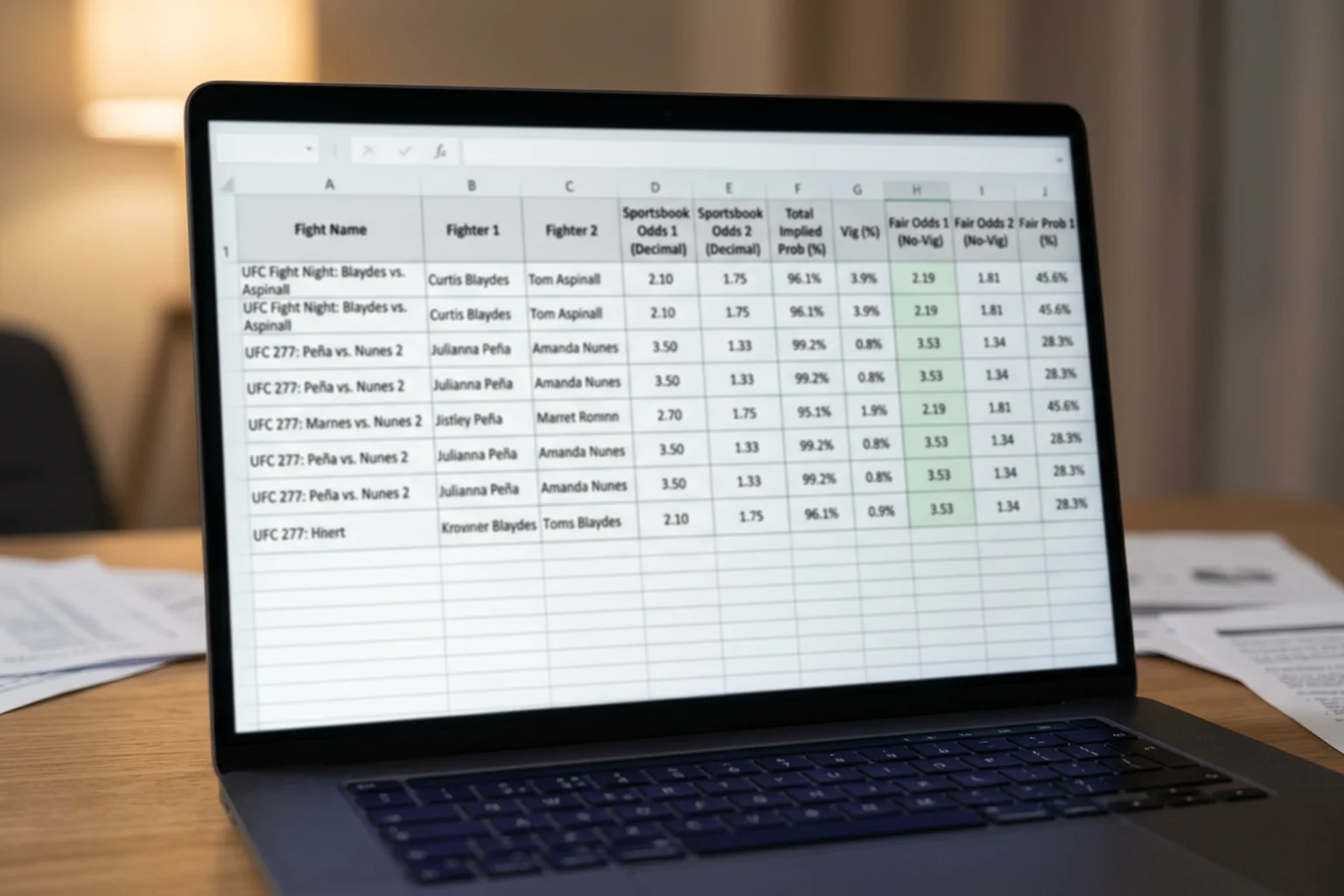
The first time I devigged a UFC line in front of a friend, he stared at the spreadsheet for thirty seconds and asked why no UK bookmaker shows you the number directly. Because they cannot. The no-vig line is the trading desk’s actual estimate of who wins, stripped of the margin that keeps the operator profitable, and showing it on the bet slip would expose exactly how much the house is charging on every fight. So the calculation lives on your side of the screen, and the punters who do it consistently are the ones who find value the rest of the market misses.
Devigging is a two-step process anyone can do on a phone calculator. The aim is to take a UFC market that adds up to 105 or 107 percent in raw implied probability and rescale it so it adds to exactly 100. The result is the no-vig line – sometimes called the fair line or true line – and once you have it, you can compare your own probability estimate against the book’s without margin interference. For the upstream concept of implied probability that this calculation builds on, see the implied probability walkthrough. This piece is about the cleanup step.
Strip bookmaker margins using formulas from our homepage.
Why the Margin Distorts the Price You See
Every UK sportsbook books UFC markets to a number above 100 percent. A balanced book on a two-fighter moneyline lands somewhere between 104 and 108 percent implied probability total, with the best UK operators pricing as low as 104 percent on major UFC cards and the industry average sitting closer to 105 to 107 percent. That excess is the operator’s gross margin per bout.
Think of it like a corner shop pricing a bottle of water. The wholesale cost is 30 pence. The shop sells at 80 pence. The 50 pence in between is margin – it pays the rent, the staff, and the owner’s profit. UFC odds work the same way. The trading desk knows the underlying probability of fighter A winning is, say, 65 percent. They quote a price that implies 68 percent. That 3-point gap is their margin slice on fighter A’s side. They do the same on fighter B. The sum overshoots 100 because every fighter is priced shorter than fair.
Until you reverse the markup, every comparison you make is corrupted. Your own probability estimate has to beat the inflated implied number, not the fair one, which means you only ever bet when your edge is unusually large. Devigging puts you on a level playing field with the trading desk and lets you see the same number they see.
The Additive Method, Step by Step
I use the additive method on UFC moneylines because it is fast, mental-arithmetic friendly, and accurate enough for two-way markets. The steps are simple. First, convert each fighter’s decimal price to raw implied probability – 1 divided by the decimal, times 100. Second, add the two raw probabilities. Third, divide each raw probability by the total and multiply by 100. The new pair adds to exactly 100.
Run it on a hypothetical bout. Fighter A is decimal 1.55. Fighter B is decimal 2.50. Raw implied: A is 64.5 percent, B is 40.0 percent. Total is 104.5 percent – overround of 4.5 percent, which is on the sharp end of the UK market. Divide: A is 64.5 divided by 104.5, which equals 61.7 percent. B is 40.0 divided by 104.5, which equals 38.3 percent. Sum is exactly 100. The fair decimal prices behind these probabilities are 1.62 for A and 2.61 for B. Both quoted prices are shorter than fair by roughly the same proportion.
Now compare. The book quoted A at 1.55, the fair price is 1.62. If your estimate says A wins 64 percent of the time, you have a 2 to 3 percentage point edge against the fair line – a small edge but a real one. If your estimate matches the 61.7 percent fair number within a single point, there is no bet. You are paying for someone else’s margin if you stake anyway.
The Multiplicative Method for Asymmetric Markets
The additive method assumes the margin is spread evenly across both sides. On heavy favourites it is not. When a UFC champion goes off at decimal 1.10 against a late-notice challenger at 9.00, the trading desk weighs the margin more onto the underdog because almost all the action will be on the favourite. The additive method underestimates the underdog’s true probability in those cases.
The multiplicative method handles this asymmetry. The formula uses logarithms, which puts off some punters, but the intuition is straightforward. Each fighter’s no-vig probability equals their raw implied probability raised to a power that makes the two sides sum to 100. In practice, you set up a spreadsheet with a solver, or you accept a small approximation by using the additive method anyway and noting that on lopsided markets your underdog estimate is conservative.
For day-to-day UK UFC betting, the additive method is sufficient on moneylines priced between 1.30 and 4.00 – which covers roughly 80 percent of UFC main and co-main bouts. Save the multiplicative method for genuinely lopsided opening lines or for three-way method-of-victory markets where the margin distribution matters more.
Comparing the Two Methods on a Real Spread
Take a champion at decimal 1.20 against a heavy underdog at decimal 5.50. Raw implied: champion 83.3 percent, underdog 18.2 percent. Sum is 101.5 percent – tighter than usual because the book has compressed the margin into the underdog. Additive devig: champion is 83.3 divided by 101.5, which equals 82.1 percent. Underdog is 17.9 percent.
Multiplicative devig on the same prices, run through a solver, gives the champion 81.0 percent and the underdog 19.0 percent. The two methods differ by 1.1 percentage points on the underdog – which translates to roughly 0.30 of decimal price at the long end. For a £20 stake at the underdog, that is the difference between a £100 profit and a £106 profit. Small in absolute terms, meaningful if you are looking for closing line value across hundreds of bouts.
The takeaway: on balanced two-way markets, the methods converge to within half a percentage point. On lopsided markets the gap widens, and the multiplicative method is the more honest answer.
Where No-Vig Lines Will Mislead You
A devigged line is the book’s best estimate. It is not the truth. Trading desks are wrong all the time – especially on UFC, where styles, weight cuts, and late-notice replacements can flip a price by a full decimal point inside a week. Treating the no-vig number as a hard ceiling on what is bettable removes the bet that actually wins you money: the bet where your information is better than the book’s.
Leverage your de-vigged fight prices into building models to spot long-term fight value.
Two specific traps. First, devigging the wrong book. A soft UK book that takes recreational money may carry a 7 percent overround and a slow-moving line. Devigging that price gives you a fair estimate from a desk that is not pricing efficiently. Compare to a sharp book if you can – overround under 4 percent suggests the desk is pricing on volume from sophisticated bettors. Second, devigging stale lines. If you devig a price an hour after sharp action has moved the line elsewhere, you are working from a snapshot that no longer reflects market consensus. Always compare to the closing line for a final check.
Which devigging method should I use for UFC main events?
The additive method is fine for any UFC moneyline where both fighters are priced between 1.30 and 4.00 in decimal terms. Use the multiplicative method when the favourite is shorter than 1.20 or the underdog is longer than 5.00, because the margin distribution on those markets is asymmetric and the additive shortcut undercounts the underdog’s fair probability.
Do sharp books produce a better no-vig line than UK soft books?
Generally yes. A sharp book carries a tighter overround – often under 4 percent on major UFC events compared with 5 to 7 percent across the broader UK industry – because it prices on volume from informed bettors who would punish a slow line. Devigging a sharp price gets you closer to true probability. Soft UK books often lag the market by minutes or hours on opening lines, so their devigged number is closer to where the line was rather than where it should be.
Published by the Where can i bet on ufc team.