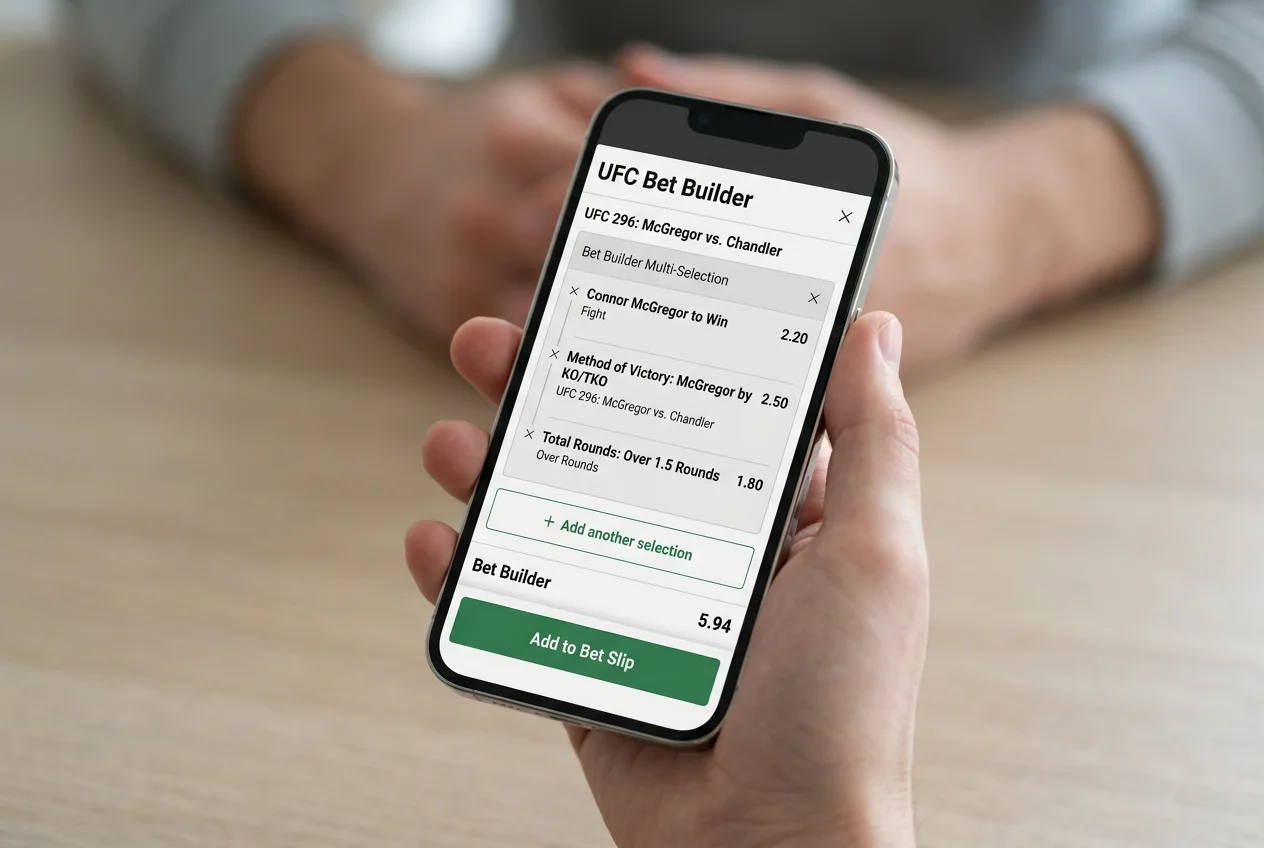
Converting UFC Odds into Implied Probability
 Available in US
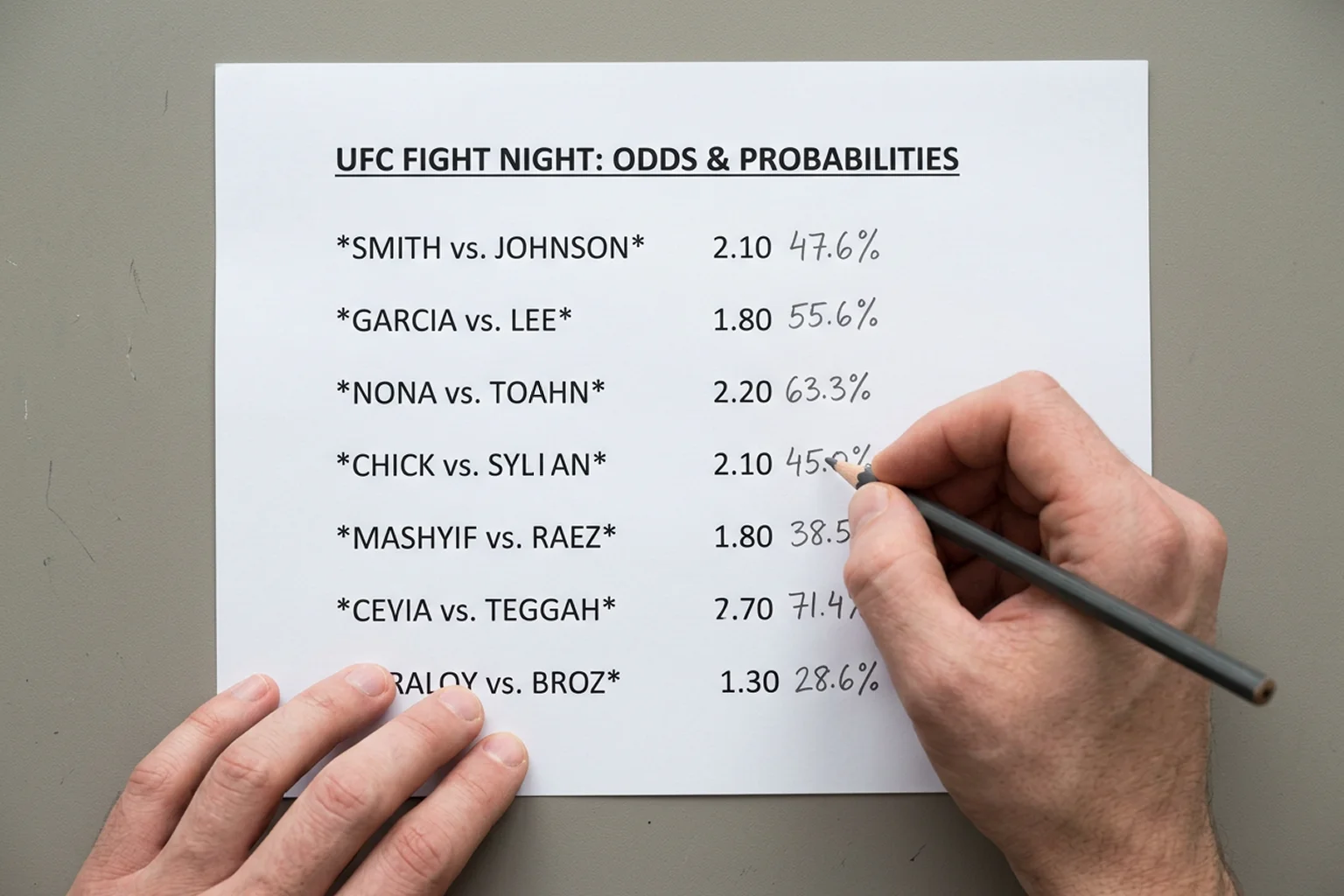
The first useful thing I learned trading UFC was that the number on the screen is not a probability. It looks like one. A favourite at 1.40 feels like an obvious bet because the price suggests the fighter “should win”. But after eight years of staring at fight cards, I can tell you that decimal 1.40 hides two things: a genuine probability estimate from the trading desk, and a layer of bookmaker margin sitting on top of it. Until you strip those two apart, you cannot tell whether the price is generous, fair, or a trap.
Implied probability is the conversion that does the unpacking. Once you can flip 1.40 into a percentage in your head, you start to see UFC odds the way a sharp does – as a marketplace where two estimates compete and the difference between yours and the book’s is your edge. The best UFC sportsbooks in the UK price markets with an overround as low as 4 percent on major cards, while the industry average sits between 5 and 7 percent. That gap is exactly the bit you need to find before placing a stake. This piece walks you through how.
Convert fractional and decimal fight prices easily on the landing page.
What Implied Probability Actually Tells You
A friend once stuck £200 on a UFC favourite at decimal 1.30 and told me confidently the fighter had a 77 percent chance of winning. The maths checks out – 1 divided by 1.30 is roughly 0.77, or 77 percent. But that 77 is not a probability of winning. It is the share of the book the operator has allocated to that fighter once their margin is baked in.
Implied probability is what the price implies a fair coin-flip percentage to be. When a UK book displays 1.30, the implication is “we have priced this fighter so we collect 77 pence of every pound of action on him”. Stake £1 at 1.30, get £1.30 back if right. The decimal 1 divided by the price is the percentage. Decimal 2.00 implies 50 percent. Decimal 4.00 implies 25 percent. Decimal 6.00 implies 16.67 percent.
Now the trick. The two sides of any UFC fight should imply 100 percent between them – fighter A wins or fighter B wins, no draws in regulation MMA. But if you add the percentages on a typical UK book, you get 104, 105, 106 percent. That extra is the overround, the bookmaker’s margin, and the reason implied probability is not the same as actual probability. Until you subtract it, you are reading a number that includes the cost of the book staying in business.
So the workflow has two steps. First, calculate the raw implied probability from each price. Second, strip the overround so the percentages add to 100. The second step is what reveals the trading desk’s actual estimate of who wins.
The Two Formulas You Will Use Every Fight Week
Two formulas cover everything you will need. Memorise them once, use them for the next ten thousand UFC bets.
From decimal: implied probability equals 1 divided by the decimal price, multiplied by 100. So 1.50 becomes 1 divided by 1.50, which is 0.667, multiplied by 100 – that is 66.7 percent. A fighter at decimal 3.00 has an implied probability of 33.3 percent. A fighter at decimal 1.20 sits at 83.3 percent. The pattern: the shorter the decimal, the higher the implied percentage.
From fractional: implied probability equals the denominator divided by the sum of numerator and denominator, multiplied by 100. So 1/2 is 2 divided by 3, which is 0.667 or 66.7 percent. So 11/4 is 4 divided by 15, which is 0.267 or 26.7 percent. Evens – written as 1/1 – is 1 divided by 2, which is exactly 50 percent.
Beginners forget the denominator-on-top trick with fractional. The bigger number goes on the bottom of your division when you are calculating probability. If you blank on this on fight night, just convert to decimal first – divide top by bottom, add one – and use the decimal formula.
Useful mental anchors: decimal 2.00 is always 50 percent. Decimal 3.00 is 33.3 percent. Decimal 4.00 is 25 percent. Once those three are locked in, you can guess the rest within two percentage points by interpolation.
Stripping the Overround From a UFC Market
Here is where most UK punters stop reading the maths and start losing money. The two-fighter implied probabilities almost never add to 100. They add to 104, 105, 107 – sometimes 110 on cards where the trading desk has limited confidence and wants protection. That excess is the overround. The trading desk has loaded the book on both sides so that whichever fighter wins, the book takes its cut.
Strip it like this. Add the two raw implied probabilities. Divide each side by that total. Multiply by 100. The two new percentages now add to exactly 100, and they represent the trading desk’s actual estimate of who wins – sometimes called the no-vig line, the fair line, or the de-vigged price.
Example. Fighter A at decimal 1.50, fighter B at decimal 2.60. Raw implied: A is 66.7 percent, B is 38.5 percent. They sum to 105.2 percent – that is a 5.2 percent overround, which sits inside the industry norm of 5 to 7 percent. Now divide. A is 66.7 divided by 105.2, which is 63.4 percent. B is 38.5 divided by 105.2, which is 36.6 percent. They add to 100. That is what the book actually thinks: A has a 63 percent chance, B a 37 percent chance.
Compare that to the raw 66.7 percent for A. Six percentage points evaporated. Six points in implied probability is the difference between a profitable strategy and a slow grind into the red. The full mechanics of devigging – including the multiplicative method, which differs slightly on lopsided cards – sit in the no-vig UFC line calculation walkthrough.
Walking Through a Real UFC Main Event
Pick a numbered UFC main event. The champion is decimal 1.40 to defend the title. The challenger is decimal 3.10. These are the kinds of prices that turn up week after week on cards where the matchmaker built a clear styles edge for the champion but the underdog still has a finishing path.
Step one. Raw implied: champion is 1 divided by 1.40, which is 71.4 percent. Challenger is 1 divided by 3.10, which is 32.3 percent. Sum is 103.7 percent – overround of 3.7 percent, which is sharper than the industry norm and suggests this is a high-profile bout where the book has tightened the lines because action will be heavy and balanced.
Step two. Devig. Champion is 71.4 divided by 103.7, which is 68.9 percent. Challenger is 32.3 divided by 103.7, which is 31.1 percent. They add to 100. The book’s true estimate: champion wins 69 percent of the time, challenger wins 31 percent. The fair decimal prices behind those probabilities would be 1.45 for the champion and 3.22 for the challenger. The actual quoted prices of 1.40 and 3.10 each contain a margin slice – the champion’s price is shorter than fair, the challenger’s is shorter than fair too.
That second point matters. Both prices are worse than fair, not just one. On lopsided lines – say, a champion at 1.15 against a late replacement – the margin tends to load more heavily on the underdog because the book expects almost all the volume on the favourite.
Now overlay your own probability estimate. If your model – built from fight metrics, finishing rates, and styles – gives the challenger a 36 percent chance of winning, you have found 5 percentage points of edge against the no-vig line of 31 percent. That is a clean betting signal. If your estimate is 28 percent, the book is sharper than you and there is no value on either side.
Spotting Value: When the Number Tells You to Bet
I keep a simple rule on my desk: never stake unless my probability estimate exceeds the no-vig implied probability by at least 3 percentage points on a favourite or 4 points on an underdog. Underdogs need a wider edge because longshot variance is brutal.
Convert sports betting lines with precision by referring to our decimal to fractional odds conversion table.
How do you build your own estimate? Start with the no-vig line and adjust. If you think the matchmaker has overrated the favourite because the underdog has a finishing path the champion has not seen, nudge your number up for the underdog by 2 to 5 percentage points. If you think the favourite is underpriced because the underdog took the fight on short notice, nudge the favourite up by 3 to 8 points.
The trap is treating implied probability as truth. The book is not always right, but it is right more often than any single punter. Use the maths to find disagreements with the line, not to validate the line. If your estimate matches the no-vig probability within 2 percentage points, there is no bet.
Reader Questions on Probability Maths
Is implied probability the same as the actual chance of winning?
No. Raw implied probability includes the bookmaker’s overround, so a fighter at 1.40 implies 71.4 percent but the trading desk’s true estimate sits closer to 68 to 69 percent depending on the margin baked into the market. Strip the overround first, then compare to your own estimate.
Where does the missing percentage go after I strip the overround?
It is the bookmaker’s gross margin on the fight. On a 105 percent two-fighter market, the 5 percent excess is the operator’s expected hold across all action booked on that bout. UK sportsbooks operate inside this margin as a business model – the industry norm sits between 5 and 7 percent on UFC main events, with the sharpest UK books pricing as low as 4 percent on major cards.
Prepared by the Where can i bet on ufc editorial staff.