UFC Betting UK Regulation: Checks, Levies and Rules
 Available in US
Table of Contents
- Who regulates UK sports betting and what they actually do
- How to verify a UFC bookmaker holds a current UKGC licence
- Age verification, ID and the first deposit you make
- The 150 pound rule and what triggers a financial vulnerability check
- The 2025 gambling levy and the 1.1 percent operators now pay
- The 2026 Remote Gaming Duty rise and what it means for your odds
- Payout speeds, account restrictions and the bookmaker’s right to refuse
- GamStop and self-exclusion for UFC bettors who need a break
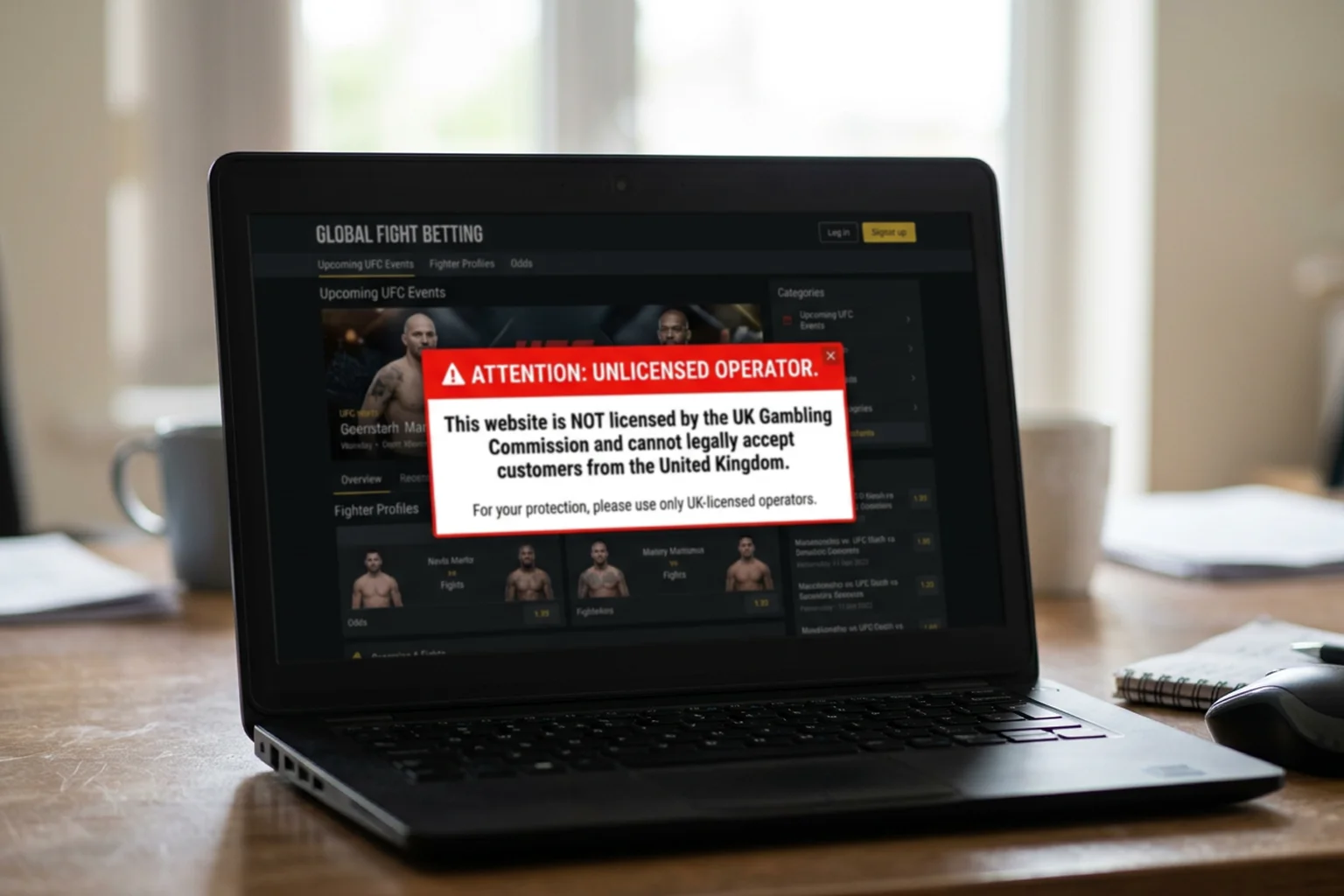
- Unlicensed offshore sites and why the price is never worth it

The first compliance call I ever had to make to a sportsbook was about a £143 withdrawal. The customer had spent the day backing favourites on a UFC card, hit four out of five, and was trying to take £143 out of his account. The withdrawal got flagged automatically. Within twenty minutes he had received an automated email asking for proof of identity, source of funds, and a passport scan. He was furious. He was also entirely within the system the UK has built — and the UK system, for all its frustrations, exists because the alternative is markedly worse.
UK UFC betting in 2026 sits inside one of the most regulated gambling regimes on the planet. Total UK gambling industry gross gambling yield reached £12.6 billion in the financial year to March 2025, up 9.3% year on year. Every penny of that flowed through licensed operators answerable to the UK Gambling Commission, and every UFC bet on a UK site is subject to the same rules as a horse racing accumulator or an online slot — with a few twists specific to sports markets.
This guide walks through what the UKGC actually regulates, the checks you will encounter when you sign up, the rule changes of 2025 and 2026, and the practical implications for anyone betting on UFC inside the regulated market. I will cover the £150 financial vulnerability threshold introduced in February 2025, the statutory levy that landed in October 2025, the Remote Gaming Duty rise of April 2026, payout speeds, account restrictions, and the unlicensed offshore sites you should stay away from. The rules are denser than they were five years ago. Most of them genuinely protect you.
Play safely and within legal bounds with resources from the homepage.
Who regulates UK sports betting and what they actually do
The UK Gambling Commission turned twenty in 2025, and it spent the anniversary year doing what it has done every year since 2005 — quietly tightening the rules. The Commission ran 9,700 compliance assessments in the 2024-2025 reporting period against 4,200 the year before. That more-than-doubling of regulatory pressure is not a statistical accident. It is the regulator telling the industry that the era of loose oversight is finished.
The UKGC is the statutory body responsible for licensing and supervising all commercial gambling in Great Britain — sports betting, casino, bingo, lotteries, the lot. Northern Ireland operates under separate legislation. The Commission’s powers cover both the operators (who need an operating licence to take bets from UK residents) and the individuals running them (who hold personal management licences and are personally liable for compliance failures). Fines run from token sums to nine-figure penalties. Operators have, in recent years, surrendered licences rather than face the regulatory consequences of continued breaches.
The chief executive Andrew Rhodes has been explicit about the direction of travel. In his November 2025 CEO Briefing he confirmed that the regulator’s caseload of criminal cases had grown 300% year on year, much of it relating to betting integrity and unlicensed operators. The message to the industry is that compliance is no longer a paperwork exercise; it is a continuous obligation enforced with criminal-law tools.
For UFC punters, the practical effect is that every UK-licensed sportsbook offering MMA markets must maintain anti-money-laundering controls, financial vulnerability monitoring, integrity reporting to the regulator and partner bodies, and player protection measures including deposit limits and reality checks. None of those obligations are optional. A site that does not have them is not operating under a UK licence — and if it claims to, the claim is testable in about ninety seconds, which is the subject of the next section.
How to verify a UFC bookmaker holds a current UKGC licence
The most useful three minutes I spend before recommending any sportsbook to anyone is verifying its UKGC licence is current. The process is straightforward, the regulator publishes its register openly, and the answer comes back as a yes or no — without ambiguity, without spin, without a marketing department in between.
The starting point is the footer of the sportsbook’s website. UK-licensed operators are required to display their UKGC operating licence number, the licensee name (which is often the corporate parent and may not match the trading brand), and a link to the licensee’s status on the public register. If the footer does not contain these elements, the site is not UK-licensed. There is no exception to this rule; it is a hard requirement under the regulator’s display conditions.
The licensee number is the key piece of information. Copy it into the UKGC’s public register search and the system returns the licensee’s current status — active, surrendered, lapsed, or revoked — alongside the categories of activity the licence covers. A bookmaker offering remote sports betting needs a remote general betting standard licence; a site offering casino games alongside sports needs the relevant casino entries on the same licence. If the categories on the licence do not match the products being offered, the operator is either operating outside its permissions or pointing you at someone else’s licence.
The two warning signs that come up most often are mismatched names and stale licences. A trading brand that does not match the licensee’s company name is not automatically a problem — many large groups operate multiple brands under a single licence — but it warrants a second look. A licence that has been surrendered or marked as inactive is unambiguous: that operator cannot legally accept UK bets, and any site still operating under that name is doing so illegally.
I have seen offshore sites mock up UK-style footers with invented licence numbers, hoping casual punters will not check. The numbers do not appear in the register. The branding looks British. The site accepts UK bank cards. Everything about the experience is designed to feel UK-licensed without being so. If a number returns no results, the site is not licensed — and at that point what you do next matters a great deal for both your money and your legal standing.
Age verification, ID and the first deposit you make
Every UK sportsbook will demand proof of age before you place a single bet. The legal minimum is eighteen, and the regulator has made clear in the past three years that “we’ll check later” is not an acceptable answer. The trend since 2022 has been to push verification forward — before deposit, before bet placement, in most cases as the very first step after registration.
The verification check works through a combination of electronic identity services and document upload. Most UK punters never see a document request because the electronic check — running your name, date of birth, and address against credit bureau data — clears them automatically. About one in five new accounts hits an edge case where electronic verification fails, usually because the registration details do not exactly match the credit file or because the punter is too young to have established a credit footprint. At that point the operator will request a passport, driving licence, or other photographic ID, plus a recent utility bill or bank statement as proof of address.
The single most common error I see at this stage is registering with details that do not match your bank account. If you fund your account from a card or bank account in one name and the registration is in another — a partner’s bank, a parent’s card, a former surname — the account will flag, the funds will freeze, and unfreezing will take days. The system is built on the assumption that the registered account holder is also the funding source.
From a UFC betting perspective, the practical implication is that you should never try to place a bet through someone else’s account, even casually. Verification systems catch this, accounts get suspended, and winnings can be confiscated as proceeds of unverified play. The rules are tedious. They are also enforced strictly enough that working around them is not worth the time or the legal risk.
The 150 pound rule and what triggers a financial vulnerability check
The £150 net-loss threshold introduced on 28 February 2025 is the single most consequential rule change of the past five years for the average UK UFC bettor. Before that date, financial vulnerability checks kicked in at higher thresholds and varied between operators. After it, the line is drawn at £150 in net losses over a rolling 30-day window, applied consistently across the industry. Cross it and the automated compliance machinery starts asking questions.
The trigger is net loss, not gross stakes. If you stake £500 across the month and win £400 back, your net loss is £100 and you do not cross the threshold. If you stake £200 and win nothing, you have hit £200 in net losses and the check engages. The mechanism is light-touch by design — the Commission’s framing is that the check should not feel intrusive to ordinary recreational players. The reality, in practice, is that ordinary recreational players are surprised by it.
The first stage of the check is a “light-touch” data lookup. The operator consults credit reference agency information — publicly available indicators of financial distress, things like county court judgments and bankruptcy filings — and if nothing concerning appears, the account continues normally. The customer may not even notice the check has happened. If a flag does appear, the operator is required to assess whether continued play would be affordable for that specific customer and to take “appropriate action,” which can range from a soft conversation to a temporary suspension while documentation is gathered.
The Minister for Gambling, Baroness Twycross, framed the policy at the BGC AGM 2025 by saying she wanted to work with the industry to see a safer, more responsible gambling environment — acknowledging that the vast majority of customers do not experience harm, but committing to do better for those who could be vulnerable. The £150 threshold is the operational expression of that policy. It is calibrated low enough to catch early signs of distress and high enough that most regular UFC punters will never trigger it.
If you do hit the threshold, the right response is not to ignore the email, switch sportsbooks, or attempt to work around the check. Other operators will get the same signal soon enough; the data shares across the industry. Respond to the request, provide what is asked for, and the check generally clears within a few days. The dedicated cluster article on how the £150 affordability threshold actually applies to UFC betting covers the documentation specifics and what to expect at each stage.
The 2025 gambling levy and the 1.1 percent operators now pay
The statutory gambling levy that took effect on 1 October 2025 has done more to reshape the UK sportsbook landscape than any single rule change since the 2014 licensing reforms. Online operators now pay 1.1% of their gross gambling yield into a statutory pot funding harm reduction; land-based operators pay 0.4%. The numbers look modest. The behavioural effect on the industry has been anything but.
Before the levy, operator contributions were voluntary, inconsistent, and frequently used as marketing collateral. The statutory levy ended that. Every UK-licensed remote sports betting operator now pays a fixed percentage of online GGY, with the proceeds directed by the regulator into research, education, and treatment of gambling harm.
For the operator, the levy is a permanent margin compression. A 1.1% line item on top of existing duties and operating costs eats directly into the budget previously available for customer acquisition. The first place that budget got cut was the high-cost promotional toolkit — the headline welcome offers, the matched free bets, the no-deposit bonuses. Operators rebalanced towards targeted, controlled promotions: specific odds boosts, profit-boost tokens for existing customers, reduced-stake free bets with stricter terms.
For the UFC punter, the practical effect is fewer headline offers, more conditional bonuses, and tighter terms on what remains. A sportsbook running a UFC main event promotion in late 2025 looks meaningfully different from the same operator’s promotion in 2023. The minimum odds are higher, the maximum stake is lower, the wagering requirements are tighter. None of these changes are illegal or anti-consumer; they are direct downstream effects of the levy reshaping operator economics.
The chief executive of the Betting and Gaming Council, Grainne Hurst, has framed industry investment in harm reduction as a sign of commitment to raising standards. Whether the framing holds depends on the next set of reforms. What is certain is that the cost of operating a UK sportsbook is now structurally higher than it was, and the customer-facing changes flow from that.
The 2026 Remote Gaming Duty rise and what it means for your odds
The Remote Gaming Duty rise to 40% from 1 April 2026 is the second shoe dropping on UK operator margins, and it is the change that will most directly affect the prices you see on UFC markets through the rest of this year. The previous rate was 21%; the new rate effectively doubles the tax burden on remote gaming. The Treasury announced it in the February 2026 Budget cycle.
The duty applies to remote gaming activity broadly — online casino, online bingo, certain online betting products. Sports betting on UFC sits primarily under General Betting Duty rather than Remote Gaming Duty, which means the headline 40% rate does not apply directly to a moneyline bet on a UFC main event. But the operator economics are joined up. A sportsbook that runs a casino product alongside its sports markets cross-subsidises across its product mix, and a 40% tax on the casino side compresses the budget available for everything else.
The direct consequence for UFC bettors comes through three channels. First, promotion budgets shrink further on top of the levy compression — fewer free bets, smaller odds boosts, more conditional bonuses. Second, soft sportsbooks that previously relied on casino cross-sell to subsidise loose betting prices will tighten their sports margins. Third, marginal operators may exit the UK market entirely, reducing the field of UKGC-licensed sportsbooks taking UFC bets.
The honest read is that the duty rise will not visibly change a UFC moneyline by a meaningful amount on the better operators. The competitive UK trading desks will hold their margins at industry-leading levels because they have to. Where the duty bites is on the soft books, the operators who priced lazily before and now have less room to do so.
Payout speeds, account restrictions and the bookmaker’s right to refuse
The UK regulated market processes withdrawals faster than most punters realise. Of 44.2 million withdrawals from UK-licensed sites between June and September 2024, 96.3% were processed automatically; 3.5% landed within 24 hours of request; only 0.1% took longer than 48 hours. Those are the numbers Andrew Rhodes presented at the IAGR 2025 conference in October last year, and they paint a picture of an industry whose payout infrastructure is in genuinely good shape.
The mechanism behind the speed is simple. Most withdrawals from verified accounts to verified payment methods clear without any human review at all. The customer requests, the system checks the account is in order and the destination is the same source the funds came from, and the payment goes out. E-wallet withdrawals — to PayPal, Skrill, or similar — typically land within minutes. Bank transfers take longer because the destination banking infrastructure is slower; that delay sits with the receiving bank, not the sportsbook.
The slow withdrawals are the ones that hit a compliance flag. Large amounts, accounts with documentation gaps, or activity patterns that trigger AML checks all push a withdrawal into manual review. The system is designed this way deliberately; the regulator’s framing is that fast withdrawals are a customer protection measure, but only when they do not bypass anti-money-laundering controls. The 0.1% of withdrawals taking longer than 48 hours are mostly in this bucket.
The harder topic is account restriction. The regulator’s 2025 data shows that 4.31% of UK gambling accounts were restricted for commercial reasons over a 12-month period — a number that includes accounts of winning customers. Rhodes was direct about this at IAGR: the practice of restricting winners is happening at scale, and the regulator is taking a closer look. The operator’s defence is that commercial discretion is part of running a business, and a customer with a sustained edge represents a structural cost the book is entitled to manage. The customer’s complaint is that a sportsbook offering “best odds” loses credibility when it stops taking bets from anyone who actually finds them.
For UFC punters specifically, account restrictions tend to follow consistent winning behaviour over time — typically across method markets or props where the trader’s pricing is less robust. There is no realistic legal recourse if you are restricted; the operator’s terms permit it. The only practical response is to spread your action across multiple sportsbooks so no single account becomes large enough to attract restriction attention.
GamStop and self-exclusion for UFC bettors who need a break
A friend of mine spent eighteen months convinced he had a system for live UFC betting. The system, in retrospect, was that he liked watching fights and the bets gave him something to do during prelims. After the fifth time he lost a month’s spending money on a single card, he registered with GamStop. He told me about it six months later, as someone might describe a useful tool. That is the right way to think about self-exclusion — not as a defeat, but as an instrument with a clear purpose.
GamStop is the UK’s free national self-exclusion scheme, mandatory for every UKGC-licensed online operator. Registration takes about ten minutes and locks the user out of every UK-licensed online gambling site for a chosen period — six months, one year, or five years. The lock is enforced at the operator level via shared identity data, which means the registered user cannot create new accounts, sign in to existing ones, or place bets on any UK-regulated site for the duration of the exclusion.
The scheme is one part of a broader toolkit. Inside individual sportsbooks, customers can set deposit limits, loss limits, session time limits, and reality checks that prompt at chosen intervals. Single-operator exclusions and account closures are also available without the GamStop nuclear option. For someone whose UFC betting has slipped into uncomfortable territory but who does not want to step away from all sports betting, the in-operator tools are usually the right place to start.
The reason GamStop matters specifically for UFC punters is the rhythm of the calendar. A fight card is a concentrated, time-bound event — five or six hours of action, often on a weekend evening, with the kind of escalation dynamic that compresses several weeks of staking behaviour into a single sitting. Punters who would never bet £200 across a normal week sometimes lose the same amount across a single UFC card by chasing prelim losses on the main event, then live-betting the main event itself. The session structure of a fight night is a known risk pattern, and the self-exclusion tools exist partly because of it.
Around 2.7% of UK adults score as problem gamblers on the Gambling Survey for Great Britain’s PGSI 8+ measure — a figure the regulator describes as “statistically stable” year on year. Among 18-to-24-year-olds the rate is materially higher. If your UFC betting has stopped being recreational, the tools to step away exist, they work, and using them carries no stigma worth caring about.
Unlicensed offshore sites and why the price is never worth it
The last category of UFC betting site I will ever recommend is the offshore unlicensed operator. Not because of the moralising tone the issue sometimes attracts, but because the practical economics for the customer are uniformly worse than the regulated alternatives, even before you factor in the legal and operational risks.
Understand the triggers of your deposit limitations by studying the system of light vs enhanced affordability checks.
The UKGC directed search engines towards roughly 200,000 URLs of unlicensed operators in the most recent financial year and tracked the traffic patterns of more than 1,000 unlicensed platforms targeting UK customers. The enforcement infrastructure is mature, the regulator’s commitment is sustained, and the offshore operators are responding by becoming more sophisticated in their UK-targeting rather than less. Marketing material that mimics UK-licensed sites, payment processors that route through legitimate-looking intermediaries, customer support running on UK time zones — the surface presentation is convincing.
The crypto-betting dimension makes this market more dangerous, not less. Andrew Rhodes has been direct about the regulator’s view, describing crypto-based betting as a problem he previously thought was five years away and now thinks is an 18-to-24-month challenge. The issue is partly enforcement — crypto rails are harder for the regulator to interdict than card payments — and partly that the customer protection infrastructure built around the regulated market does not exist on crypto-only sites. There is no GamStop, no £150 affordability threshold, no automated payout monitoring, no shared compliance data. The customer is on their own.
For UK residents, betting on an unlicensed offshore site is not specifically illegal at the customer level — the legal exposure sits primarily with the operator — but the practical risks are substantial. Disputes have no enforceable resolution path. Winnings can be confiscated arbitrarily under operator terms that no UK regulator will enforce against. Account closures happen without warning. Identity data submitted to offshore operators sits outside UK data protection enforcement. None of these risks materialise in every case; all of them materialise often enough that the offshore “better odds” pitch comes with a tax in lost recourse the customer almost never priced in.
The honest version of the offshore proposition is that you trade a small price advantage on the bet itself for a large reduction in the protections around the bet. For a casual UFC punter, the trade is bad. For a serious one, it is worse — the loss recourse you lose when an offshore operator confiscates a winning account is far larger than any price improvement you ever banked.
What happens if I deposit more than 150 pounds net loss in 30 days on a UK UFC site?
The operator runs a light-touch financial vulnerability check using credit reference agency data. The check looks for publicly available indicators of financial distress — county court judgments, bankruptcy filings, similar markers. If nothing concerning appears, the account continues normally and the customer may not even notice the check happened. If a flag appears, the operator is required to assess affordability and may ask for documentation before play continues. The threshold applies to net losses, not gross stakes.
Will the 2026 Remote Gaming Duty change the odds I get on UFC?
The 40% Remote Gaming Duty applies primarily to online casino activity rather than sports betting on UFC, which sits under General Betting Duty. The indirect effect comes through operator economics — sportsbooks that cross-subsidise sports markets from casino margins now have less budget to do so, which compresses promotions, free bets, and odds boosts. On the better-priced UFC moneylines, the change is unlikely to be visible at meaningful size. On softer books with already loose pricing, the duty rise will tighten margins further.
Is offshore UFC betting illegal for a UK resident?
Betting on an unlicensed offshore site is not specifically illegal at the customer level — the legal exposure sits primarily with the operator targeting the UK market without a licence. The practical problems are substantial regardless. Disputes have no enforceable resolution path. Winnings can be confiscated under operator terms no UK regulator will enforce. None of the consumer protections built around the regulated market — GamStop, the financial vulnerability framework, automated payout monitoring — apply. The trade-off for any small price advantage is poor.
Prepared by the Where can i bet on ufc editorial staff.