UFC Live Betting & Streaming in the UK
 Available in US
Table of Contents
- How live UFC betting actually works inside the cage
- Where UK fans watch UFC: TNT Sports and the broadcast picture
- Paramount, the 7.7 billion dollar deal, and what it means for UK viewers
- Why UK bookmakers do not stream UFC fights
- Cash out on UFC fights and how it earns its rent
- Bet builder for MMA, in brief
- Latency and the fair in-play question
- UFC pay-per-view history and the UK pricing shift

I watched UFC 311 from a friend’s flat in Hammersmith on a winter Sunday morning in 2025. Three of us, two laptops, one TV, and roughly four hours of sleep between the lot of us. The TV was running TNT Sports for the broadcast. The laptops were running two UK sportsbooks for the live markets. Nobody was streaming the fights through their bookmaker app, because nobody in the UK actually can — the UFC’s broadcast deal makes sure of it. That single fact shapes the entire UK in-play experience.
Live UFC betting in the UK is a layered ecosystem. The fight you watch comes from one place — currently TNT Sports, formerly BT Sport. The bets you place come from your sportsbook, with markets that update in real time as rounds progress. The cash-out engine that lets you exit a position mid-fight runs on the bookmaker’s own pricing model, which is responding to the same fight you are watching but with a small lag and the operator’s margin baked into the exit price. Understanding how those pieces fit together is the difference between in-play betting that pays and in-play betting that costs.
This guide covers the broadcast picture in 2026, the seven-year Paramount deal that reshaped the global UFC landscape from August 2025, why your bookmaker cannot show you the fight even when their competitor in another country can, how cash-out actually works during a UFC round, and what the bet builder and round-specific in-play markets are good for. The UK regulator’s data shows around 290.03 million online sports bets placed monthly in the UK on real events — the live market accounts for a meaningful and growing slice of that, and UFC is one of its busiest sports per fight night.
React to the fight in real-time with updates from our main website.
How live UFC betting actually works inside the cage
The first time I watched a UFC round with a live betting screen open next to the TV, I had the slightly unnerving feeling that I was watching two fights — one in the cage and one on the price feed. The cage fight was the obvious one. The price-feed fight was the trading desk’s running estimate of what the cage fight meant for the remaining time, updated every couple of seconds as the round unfolded.
Live UFC betting works by continuously repricing the moneyline and the secondary markets as the fight progresses. A favourite who takes the opening round on the cards will see their live moneyline drop sharply — from 1.85 pre-fight to perhaps 1.45 between rounds. A favourite who eats a knockdown in round one might suddenly find their moneyline drift to 2.10 even though they have not yet lost the fight. The price moves with the cage activity and with the trading desk’s view of how the activity changes the probability distribution of the remaining rounds.
The markets available in-play vary by sportsbook but typically cover live moneyline, live method of victory, next round to finish, total rounds over/under, and round-specific finish markets. Some operators offer prop markets that update in real time — first knockdown, first significant takedown, fight to go past 2.5 rounds. The depth and the speed of the markets depend on the operator’s trading capacity.
The crucial point for any UK punter using live markets is the lag between the broadcast and the price feed. Your TV broadcast carries a few seconds of delay against the trading desk’s data source, which means the trader has seen the punch before you have. Acting on what you have just watched is acting on stale information — the price you click is almost always priced against what happened a second or two before, not the moment your TV showed it. Live betting is faster than pre-fight but never faster than the trading model behind it.
Where UK fans watch UFC: TNT Sports and the broadcast picture
Ask any UK MMA fan over the age of thirty where to watch UFC and they will say TNT Sports without hesitation. Ask anyone under twenty-five and you will get a confused pause followed by “the one that used to be BT Sport, right?” Both answers are correct. The channel rebranded in July 2023, the UFC rights came with it, and in 2026 TNT Sports remains the home of UFC for UK viewers — for now.
The arithmetic of the UFC’s broadcast presence in the UK is straightforward. The new UFC deal with Paramount, signed in August 2025 and valued at $7.7 billion over seven years, is structured around US distribution. Internationally — and that includes the UK — the picture is messier. Existing broadcast partnerships in non-US territories continue under their own terms while the Paramount transition reshapes the American landscape. For UK fans through 2026, that means TNT Sports remains the principal broadcast home, with numbered events and Fight Nights flowing through the channel as they have done for years.
The viewing experience for a UK fan is straightforward in operational terms and complicated in commercial ones. TNT Sports carries the main cards and some prelims live; certain prelim cards may be streamed through the Discovery+ ecosystem the broadcaster sits inside. The numbered events run on standard TNT subscription rather than pay-per-view in 2026 — a shift from the previous model where major UFC cards required an additional PPV purchase on top of the base subscription. That change is one of the more consumer-friendly outcomes of the Paramount transition, even though the Paramount deal itself does not directly apply to the UK rights.
The historical context matters here. The UFC’s previous global broadcast cycle, anchored by the ESPN deal that ran 2019-2025, paid approximately $500 million per year. The new Paramount arrangement averages $1.1 billion per year — more than double. That doubling of media value flows from somewhere, and one place it shows up is in the rationalisation of distribution across territories. Whatever the UK arrangement looks like in 2027, it will be priced against the new global benchmark, and the days of the cheap UFC TV subscription are unlikely to return.
Paramount, the 7.7 billion dollar deal, and what it means for UK viewers
The Paramount deal is the single biggest story in UFC’s commercial history, and the UK fan needs to know what is in it and what is not. Signed in August 2025, the agreement runs for seven years, carries an average annual value of $1.1 billion, and a total contract value of $7.7 billion. It vests primary US distribution rights with Paramount and ends the pay-per-view model in the United States for subscribers to the Paramount+ streaming platform. The UK falls outside the deal’s primary distribution scope.
The structural significance of the deal is the elimination of the US PPV. In 2026 the UFC produces 13 numbered events and 30 Fight Nights, all of which flow to Paramount+ subscribers in the US without an additional PPV charge. The numbered events that historically commanded $79.99 per buy are now bundled into the streaming subscription. For the operator, this trades short-term PPV revenue for a much larger committed media rights payment from Paramount across the seven years.
David Ellison, the chief executive of Paramount Skydance, framed the rationale during the deal announcement by calling the UFC “a unicorn asset that comes up about once a decade” — the kind of property that combines live sport, controlled production, and a young engaged demographic in a single package. The phrasing is unusual; the strategic logic is conventional. Streaming services need live anchor content to sustain subscription value, and a UFC card delivers an audience of millions in a single night.
The mechanics for UK viewers in 2026 are unchanged from 2025. The Paramount deal’s primary territory is the US, and existing international rights arrangements continue under their own terms. UK fans watch on TNT Sports through 2026 with no PPV charge on the numbered events. The Paramount streaming app, where it is available outside the US, does not carry UFC live in the UK. The international rights map gets renegotiated periodically, and the next cycle will be priced against the new $1.1 billion-per-year global benchmark, but for 2026 the practical UK answer is that nothing has changed at the viewing level.
The mid-term question — whether the UFC moves towards a single global streaming distribution model after the current UK rights cycle — is something I track with interest rather than expectation. There is a more thorough treatment of the trajectory and the realistic timeline in the cluster article on the Paramount deal and what it actually changes for UK UFC fans. For the purposes of this guide, what matters is that the deal exists, its UK effect is indirect, and the broadcast home for now is TNT Sports.
Why UK bookmakers do not stream UFC fights
The most common complaint I hear from UK punters new to UFC betting is that their sportsbook will let them stream horse racing, football, tennis, and Australian rules football, but not the actual UFC fight they want to bet on. The reason is straightforward and durable: the UFC’s broadcast rights are licensed to specific media partners on a territory-by-territory basis, and UK sportsbooks are not those partners. They cannot legally carry the video feed.
Broadcast rights in sport are exclusive by design. The UFC sells its territorial rights to one or two principal partners per market — TNT Sports in the UK, Paramount+ in the US from 2026, ESPN in some other regions, DAZN in others — and the value of that exclusivity is precisely that no other entity within the territory can carry the live feed at the same time. A UK sportsbook adding a UFC video stream would be infringing TNT’s exclusive rights, and the operator’s broadcast partners would intervene.
The sports that UK sportsbooks do stream — the racing, the lower-tier football, the European tennis, the Australian rules — generally fall into one of two categories. Either the rights are held by aggregators who sub-licence to sportsbooks specifically (the racing model), or the underlying broadcast rights are sufficiently fragmented that sportsbook streaming creates no exclusivity conflict. UFC sits in neither category. Its rights are concentrated, valuable, and protected by partners with legal teams whose business is enforcement.
The closest UK sportsbooks come to UFC streaming is the play-by-play widget — a textual or schematic representation of the cage action, updated in near real time, that gives the punter something to look at without infringing the broadcast rights. The widgets are useful for live betting context but unsatisfying as a substitute for watching the fight. For the actual video, you need TNT Sports or whatever the broadcast partner offers in any given territory.
The structural conclusion is that UK punters wanting to combine live UFC viewing and live betting need two screens — one for the broadcast, one for the sportsbook. That is the model everyone I know uses, and it is unlikely to change while the rights model remains exclusive and the values remain in the billion-pound range.
Cash out on UFC fights and how it earns its rent
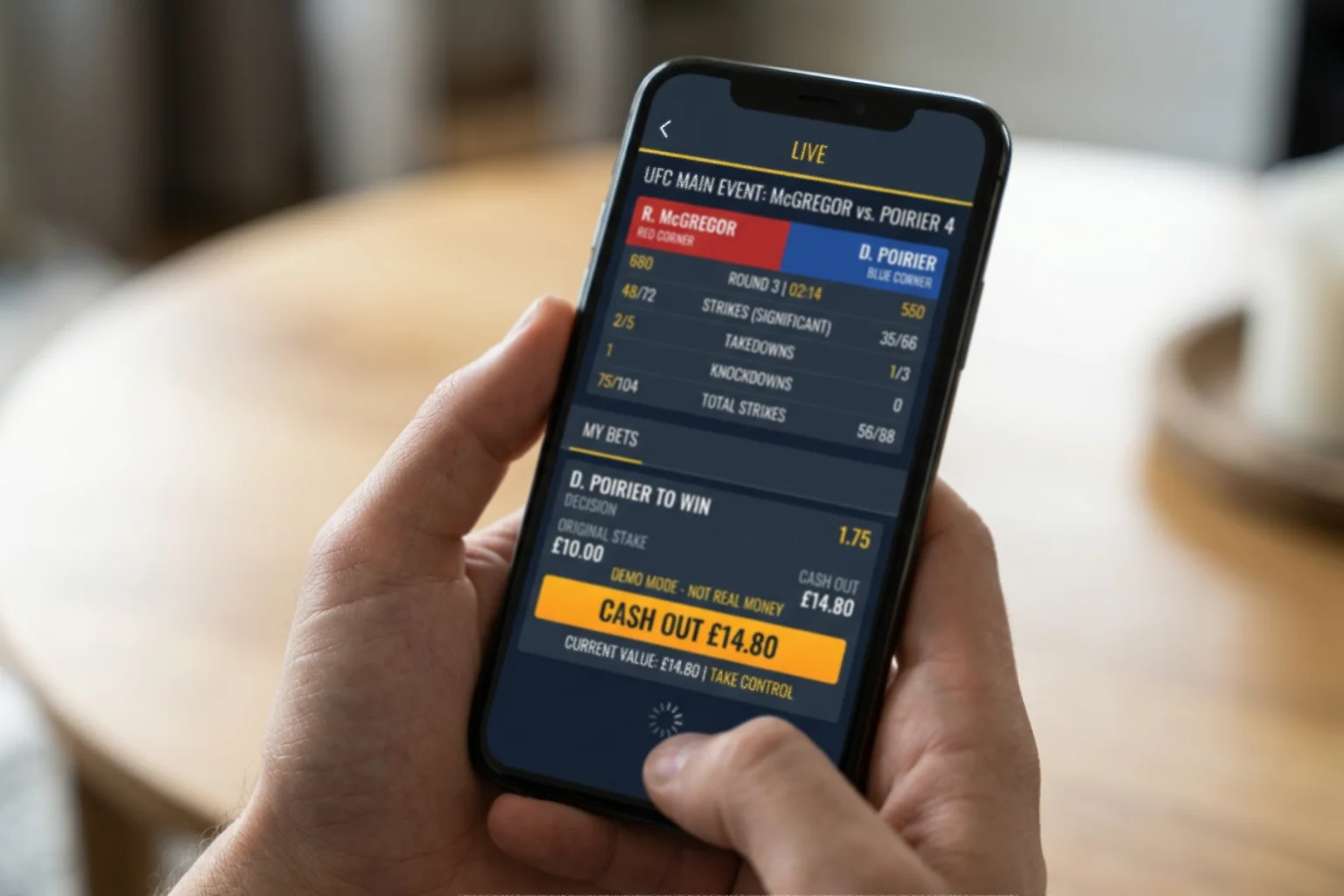
Cash out is the in-play feature that has changed the UK live UFC experience more than any other innovation of the past decade. The mechanic is simple — exit your bet before the fight ends in exchange for a price the operator calculates in real time — and the appeal is obvious: lock in profit on a fight you have backed correctly, or limit losses on one going against you. The catch is that the operator’s cash-out price is always worse than the fair exit value the underlying odds imply, and understanding that gap matters.
The mechanic works as follows. You back a fighter pre-fight at 2.50 with a £20 stake. After round one, your fighter is comfortably ahead and the live market has them at 1.45. The fair exit price — what you would get on a no-margin market — sits around £20 multiplied by 2.50 divided by 1.45, roughly £34.50, against your original £50 potential return. The operator’s actual cash-out offer will sit below that fair value, perhaps £31 or £32, with the difference representing the operator’s margin on the exit. You can take the £31 now or risk the bet riding to the final result.
The behavioural pull of cash out is enormous. Knowing you can lock in a profit makes the punter feel safer about taking it, and operators know this — cash-out volume runs at material levels on every UFC card, particularly for accumulator bets where multiple legs have already resolved and one remains. The operators are not running cash out as a customer service. They are running it because the average punter exits at prices that, in aggregate, leave more margin in the operator’s hands than letting bets run to settlement would.
The cases where cash out makes structural sense are narrower than the marketing suggests. Locking in a profit against a sudden injury or stoppage risk — the underdog who has gone the distance but might still get caught — has defensible logic. Limiting losses on a clearly broken bet has emotional value even if it is not always financially optimal. Cashing out a healthy bet on a fighter still likely to win is usually leaving expected value on the table.
The disappearing cash-out price is another phenomenon worth understanding. During fast action — an active scramble on the ground, a heavy exchange against the cage — the operator may pull the cash-out button entirely while the trading model catches up with the activity. The button returns once the situation stabilises. The behaviour is intentional, not a glitch; it prevents punters from exiting at stale prices during periods when the model cannot accurately price the position.
Bet builder for MMA, in brief
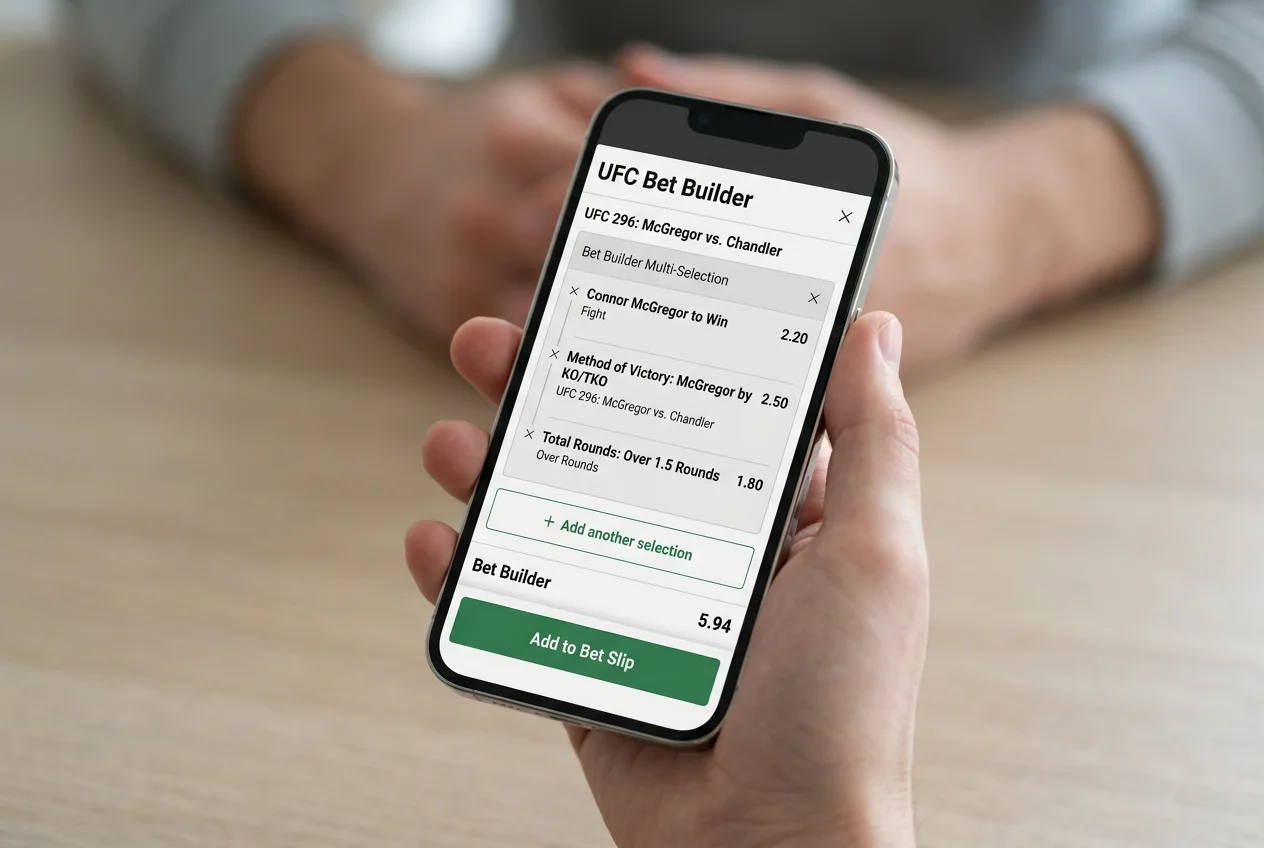
Bet builder is the in-play and pre-fight tool that lets a punter combine multiple selections from the same UFC bout into a single wager — fighter to win, fight to go past 2.5 rounds, method of victory all on one slip — at a combined price computed by the sportsbook’s correlated-pricing model. The product exists because the same-fight accumulator is a category casual punters love and traditional accumulator pricing handled badly.
The technical innovation behind bet builder is correlated pricing. A traditional accumulator multiplies the prices of independent events. A bet builder pricing two events from the same fight — say, fighter to win and fight to go the distance — has to account for the fact that those outcomes are correlated. If the fighter wins by decision, both legs hit. If the fighter wins by early KO, the win leg hits but the distance leg misses. The correlation has to be modelled correctly or the operator either underprices (and loses money) or overprices (and loses customers). Bet builder is the product that emerged once trading desks could model the correlations reliably.
The appeal for the UK punter is real. A standard moneyline on a heavy favourite pays poorly. A bet builder combining the moneyline with a likely method — favourite to win, fight to end inside 2.5 rounds, finish by KO — turns a 1.40 wager into a 4.50 wager that pays meaningfully if the matchup goes as expected. The margin the operator builds in is larger than on a single market, but the upside compensates if the legs are correctly chosen.
Where bet builder goes wrong for punters is the same place all combined markets go wrong: overstacking. The instinct is to add legs until the price is interesting, but each additional leg multiplies the probability of failure. A four-leg bet builder might price at 8.00 and look attractive; the joint probability of all four legs landing is often well under 12.5%, and the operator’s margin on the joint market eats the rest. Two or three carefully chosen, structurally correlated legs is where bet builder works. Beyond that, the maths turns against you quickly.
Latency and the fair in-play question
The fairness question in live UFC betting comes down to latency, and the latency picture is structurally tilted in favour of the operator. The trading desk receives the fight data — directly from the venue, often through an official data partner with cage-side feeds — before that data reaches any consumer broadcast. By the time the picture arrives on TNT Sports for the UK viewer, several seconds of cage action have already happened, been observed by the trading model, and been priced into the live markets.
The lag varies but is rarely under three to five seconds and can be longer in some broadcast paths. The practical implication is that any live bet you place based on what you have just watched is a bet on information the trading desk had several seconds before you. Acting on what your eyes have seen against a price the trader saw several seconds ago is a structural losing strategy.
The defensible live-betting approach inverts this dynamic. Rather than reacting to what you have just seen, you place live bets based on structural reads — round-by-round expectations about the fight pattern, projected fatigue points, anticipated game-plan adjustments — and you accept that the price feed is always going to be one step ahead of the broadcast you are watching. The trading model is not magic; it is just faster than you. Your edge comes from a better matchup read, not from quicker reactions.
The other latency consideration is the bet-acceptance delay built into most operators’ systems. When you click to place a live bet, the operator’s platform holds the wager for a short delay — typically two to five seconds — to confirm the price has not moved materially during the click. If the price has moved, the bet is offered at the new price for re-confirmation. If it has held, the bet accepts. This is sometimes called “bet referral” and is one of the more controversial features of live markets, since it gives the operator a final check that the punter does not get.
None of this makes live UFC betting unfair in the sense of being rigged. It does mean that the structural advantage sits with the operator and that punters who treat live betting as a reflex game lose money. Treat it as a structured, anticipatory exercise and the maths becomes survivable.
UFC pay-per-view history and the UK pricing shift
The UFC’s pay-per-view business has produced one of the cleaner natural experiments in modern sports broadcasting, and the numbers from the final years of the model tell the story of why it ended. UFC 300 in April 2024 — Alex Pereira against Jamahal Hill — drew 615,000 PPV buys at $79.99 per purchase. By UFC 311 in January 2025, the Makhachev-Moicano main event drew 240,000 buys; UFC 312, the du Plessis-Strickland rematch a month later, drew 176,000. The trajectory from peak to commercial breakdown took less than a year.
Plan your viewing schedules and read about the broadcasting implications of the Paramount UFC deal.
The decline did not happen because the product got worse. UFC 311 and 312 were both championship-level cards with credible main events. The decline happened because the price-to-value calculation broke for the marginal customer. Subscription bundles in the US made every other premium sport accessible without a per-event charge; the UFC PPV started to feel like a stranded business model from another decade. The Paramount deal, announced in August 2025, simply formalised the conclusion the buy numbers had already reached.
For the UK fan, the PPV picture has been different from the US picture for years. UK numbered events have historically been packaged into the broadcast partner’s subscription, with PPV charging applied selectively rather than as the default model. In 2026, UK viewers watching through TNT Sports access the numbered events without an additional PPV purchase — a position the US has only just reached for Paramount+ subscribers through the new deal.
The wider commercial picture for the UFC continues to strengthen. Global UFC revenue in 2025 reached $1.502 billion, up 7% year on year, with adjusted EBITDA of $851.0 million. The doubling of media rights value from the ESPN cycle ($500 million per year) to the Paramount cycle ($1.1 billion per year) is the headline number, but the underlying operating performance has been growing steadily through it. The UFC is not a property in commercial difficulty. The PPV model ended because a better model became available, not because the audience disappeared.
What the post-PPV era means for UK pricing is uncertain in the medium term and stable in the short term. Through 2026 the UK access proposition is materially more favourable than the previous PPV era. Beyond 2027, with international rights cycles renegotiating against the new global benchmarks, UK subscribers should expect upward pricing pressure as the underlying media-rights value increases.
Which UK broadcaster shows UFC live in 2026?
TNT Sports — formerly BT Sport before the July 2023 rebrand — remains the primary UK broadcast home for UFC throughout 2026. Numbered events and Fight Nights run on the standard TNT Sports subscription without an additional pay-per-view charge. Some prelim content may flow through the Discovery+ ecosystem the broadcaster sits within. The Paramount deal announced in August 2025 primarily reshapes US distribution; international rights arrangements continue under their existing terms during the current cycle.
Why does cash-out sometimes disappear during a UFC round?
The operator’s cash-out engine pulls the button when the trading model cannot accurately price the position — typically during fast cage action like an active ground scramble or a heavy striking exchange. The behaviour is deliberate, not a malfunction. It prevents punters from exiting at stale prices during periods when the underlying probability is moving too fast for the model to keep up. The button returns once the situation stabilises and the model can compute a defensible exit price.
Will the Paramount deal end UFC pay-per-view in the UK?
The Paramount deal eliminates US pay-per-view for Paramount+ subscribers but does not directly affect UK distribution. The 7 billion 700 million dollar agreement is structured around US rights, with international territories continuing under their existing partnerships during the current cycle. UK fans access numbered events through TNT Sports without PPV charges in 2026. Future cycles will be priced against the new global media rights benchmark of 1.1 billion dollars per year, which is likely to push UK subscription pricing upward beyond 2027.
Published by the Where can i bet on ufc team.