UFC Betting Odds Explained: A Guide for Beginners
 Available in US
Table of Contents
- What UFC odds actually tell you
- Decimal odds, the UK default for MMA
- Fractional odds and why your bookmaker still shows them
- Converting between decimal and fractional without losing your mind
- American odds and why UK punters keep bumping into them
- Implied probability and the search for an edge
- Overround, margin and how the bookmaker pays the rent
- How a UFC fight price moves in the week before the bout
- Odds boosts and promotional prices in the post-levy market

The first UFC card I priced up professionally was a Fight Night in Glasgow, eight years ago. I remember watching the same headline favourite quoted at 1.36 on one UK book, 4/11 on another, and -275 on an American site I had open in a separate tab. Three numbers, one fighter, the same fight. It looked like a translation problem. It mostly was.
That trap swallows half the UK punters I talk to. They learn one format, place a few bets, and assume the price they see is the price the market believes. It is not. A UFC odd is a compressed sentence — part probability, part bookmaker margin, part live adjustment to where the money is going. Until you can decompress it, you are betting blind.
In this guide I will walk you through every format you will meet on a UK sportsbook in 2026 — decimal, fractional, and the American notation that creeps in from US-facing analysts. Then I will show you the calculation that actually matters: turning a price into an implied probability, stripping out the overround, and deciding whether the bookmaker has given you an edge or just an invitation. The current benchmark on a major UFC event is an overround under 4% on the better UK books, with the industry average sitting at five to seven percent — and that gap is where this article earns its keep.
Understand how sportsbooks frame their prices on our main website.
What UFC odds actually tell you
Years ago a friend asked me to settle an argument with his brother: which of two fighters was the “real” favourite at 1.50 versus 6/4? They had been arguing for twenty minutes. The answer is that those are the same price. The argument was not about fighters, it was about formats — the level of confusion the UK market tolerates, costing people money every weekend.
An odd is a contract. The bookmaker is telling you what they will pay back if you win, and embedded in that number is what the market thinks about how likely it is you will win at all. Read the price wrong and you have no idea whether you are getting value or paying tax to the house.
Every UFC fight on a UK sportsbook generates at least two prices the moment markets open, often fifteen or twenty more for method of victory, round groupings, total rounds, and props. Each carries the same three components — a probability estimate, a margin the bookmaker adds, and a live adjustment as money flows in. When you see the price tick from 2.10 to 2.05 in the hour before the walkout, you are watching the market eat the available value while you decide.
The other thing odds tell you, less obviously, is what the bookmaker is willing to defend. A price held firm through heavy money is a price the trader believes in. A price that drifts in the final hours is one the book is happy to lay off. Once you can read the format, you can start reading those signals.
Decimal odds, the UK default for MMA
Decimal is the format that finally killed the calculator on my desk. For the first three years of my career I was converting fractions in my head — 7/4 means 1.75 stake returned plus 1.00 original, so 2.75 total — and I was making mistakes once or twice a card. The day I switched to a decimal-first workflow my arithmetic errors dropped to roughly none.
The number is exactly what it looks like. A decimal odd is the total return per one unit staked. Back a fighter at 1.75 with ten pounds and you get back £17.50 — that is £10 stake plus £7.50 profit. Stake times decimal equals return. No fraction reduction, no double-checking the slash.
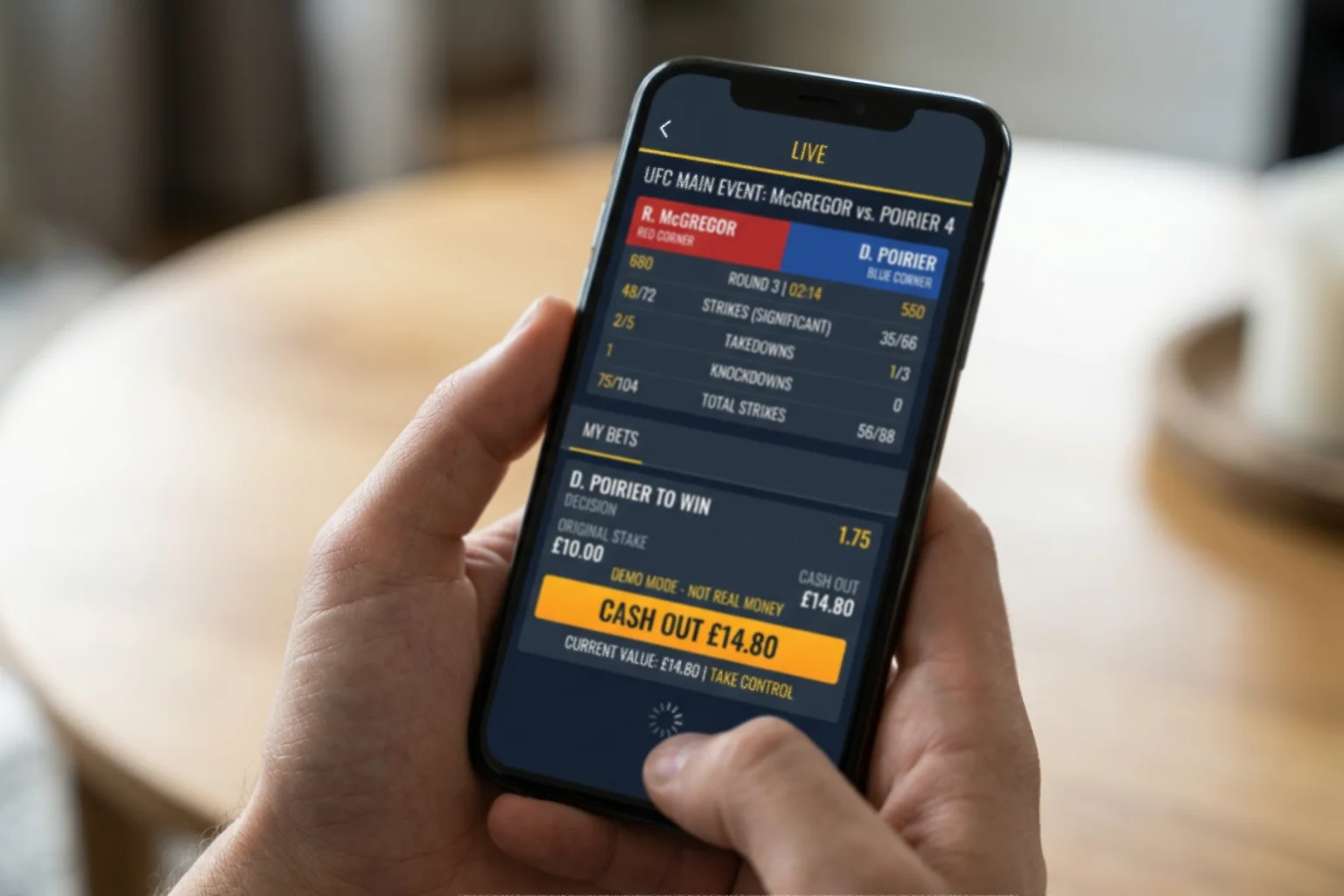
UK sportsbooks have defaulted to decimal as the primary display for almost every UFC market over the last decade. Decimal compresses a wide range of prices legibly — try writing 1.36 as a fraction without your eyes crossing, then imagine it for fifty markets on a single card — and it is what feeds every live-price algorithm, every implied probability calculator, every cash-out engine running under the bonnet. Showing the customer a different format than the system uses internally is friction the modern UK book has quietly abandoned.
What decimal makes ruthlessly clear is the gap between a short favourite and a heavy one. Most casual punters underrate how flat the curve gets at the top. A fighter at 1.20 implies the bookmaker believes they win 83.3% of the time before margin. A fighter at 1.10 implies 90.9%. That ten-pence difference in price corresponds to a seven-and-a-half percentage point swing in expected outcomes — enormous in MMA terms, where a single takedown or a clipped chin flips the result. Decimal is not a linear scale. It is the inverse of a probability, and the closer you get to certainty, the more compressed the prices become.
One practical habit I drill into anyone I work with: say the decimal out loud as a sentence. “One point seven five” becomes “I get one pound seventy-five pence back for every pound I put in.” If the sentence makes you wince — at a 1.05 favourite, risking a pound to make five pence — that is your gut doing the maths for you.
Fractional odds and why your bookmaker still shows them
The fractional odd is one of those British institutions that survives because nobody wants to be the person who turns it off. Walk into any betting shop on a Saturday morning and the boards still show horse racing in fractions. The UFC markets you bet online have largely moved on, but tap the format toggle on most UK sportsbooks and the fractions are still there.
A fractional odd is profit, not total return. That single distinction trips up more punters than every other format quirk combined. When the board reads 7/4, you make seven pounds profit for every four pounds staked — so a four-pound bet returns eleven pounds total. Compare to the decimal equivalent, 2.75, which already includes the stake. Same money, different framing. The fraction tells you what you win; the decimal tells you what you get back.
The historical logic is straightforward. Fractions evolved on the British racecourse, where bookmakers were laying odds in cash with no computer and needed numbers that could be shouted across a ring and divided in seconds. Three-to-one is easier to bark across a crowd than four-point-zero. The format stuck and is now preserved partly by display rules and partly because a slice of UK punters over fifty would mutiny if the toggle disappeared.
Where fractions still earn their keep is the short-priced end of the market. A 1/2 favourite is faster to parse than a 1.50 favourite for a generation that grew up with the slash. Evens — 1/1 — is the cleanest expression of a coin-flip price you can get. 2/1, 5/2, 3/1: these numbers carry meaning before you have done the calculation.
Where fractions break down is everywhere else. Try to write 1.36 as a fraction and you get 9/25, which nobody finds intuitive. Try 2.37 and you get 137/100, which is unreadable. UK books deal with this by rounding to the nearest common fraction — 1.36 might display as 4/11, which is actually 1.3636. The difference looks trivial. On a hundred-pound bet across a long card it is not. If two UK books show “the same” fractional price but different decimals, this is why. The fraction is an approximation. The decimal is the real number underneath.
Converting between decimal and fractional without losing your mind
I have a converter pinned in my browser bar that I have not opened in three years. The formulas are simple enough to do on a napkin, and once you have run them a dozen times you stop reaching for the tool entirely.
Fractional to decimal: divide the numerator by the denominator and add one. 7/4 becomes 7 ÷ 4 = 1.75, plus 1 equals 2.75. The “plus one” is the stake coming back. 5/2 becomes 3.50. 1/2 — an odds-on favourite — becomes 1.50.
Decimal to fractional: subtract one from the decimal and express the result as a fraction. 2.75 minus 1 equals 1.75, which is 7/4. 3.50 minus 1 equals 2.50, which is 5/2. The hard part is not the subtraction. The hard part is that decimal numbers do not always reduce to the clean fractions UK books like to display. 2.37 minus 1 is 1.37, technically 137/100, but no bookmaker will print that. They round to 11/8 (1.375) and hope you do not notice.
For a worked example, take a hypothetical featherweight main event where the favourite opens at 1.62 and the underdog at 2.38. Favourite: 1.62 – 1 = 0.62, expressed cleanly as 8/13 (which is 1.615). Underdog: 2.38 – 1 = 1.38, between 11/8 (1.375) and 7/5 (1.40); a UK book will probably show 11/8 and absorb the difference. Across millions of bets, that is not a rounding error. That is the rent.
The trap when converting is the direction of the slash. Some UK customers, especially those who learned to bet on the horses, occasionally read 1/2 as “one or two” rather than “one over two.” It is a favourite at 1.50 in decimal, not an underdog. The rule is that if the left number is smaller than the right, the fighter is the favourite — you risk more to win less. To drill the conversion until it becomes second nature, the decimal to fractional conversion table for common UFC prices covers the prices you will actually meet on a UK sportsbook.
When you toggle a UK book between formats, the underlying probability does not change — only the display. If switching appears to change the price by a meaningful amount, you are watching the rounding distortion, and it is a signal to calculate from the decimal value the system actually uses.
American odds and why UK punters keep bumping into them
You cannot follow MMA Twitter for a week without an American analyst quoting a price as -150 or +220 and assuming everyone reading speaks the same dialect. UK punters tend to either fake it or quietly bounce off the conversation. The American format is genuinely awkward, but it is decodable in about ninety seconds.
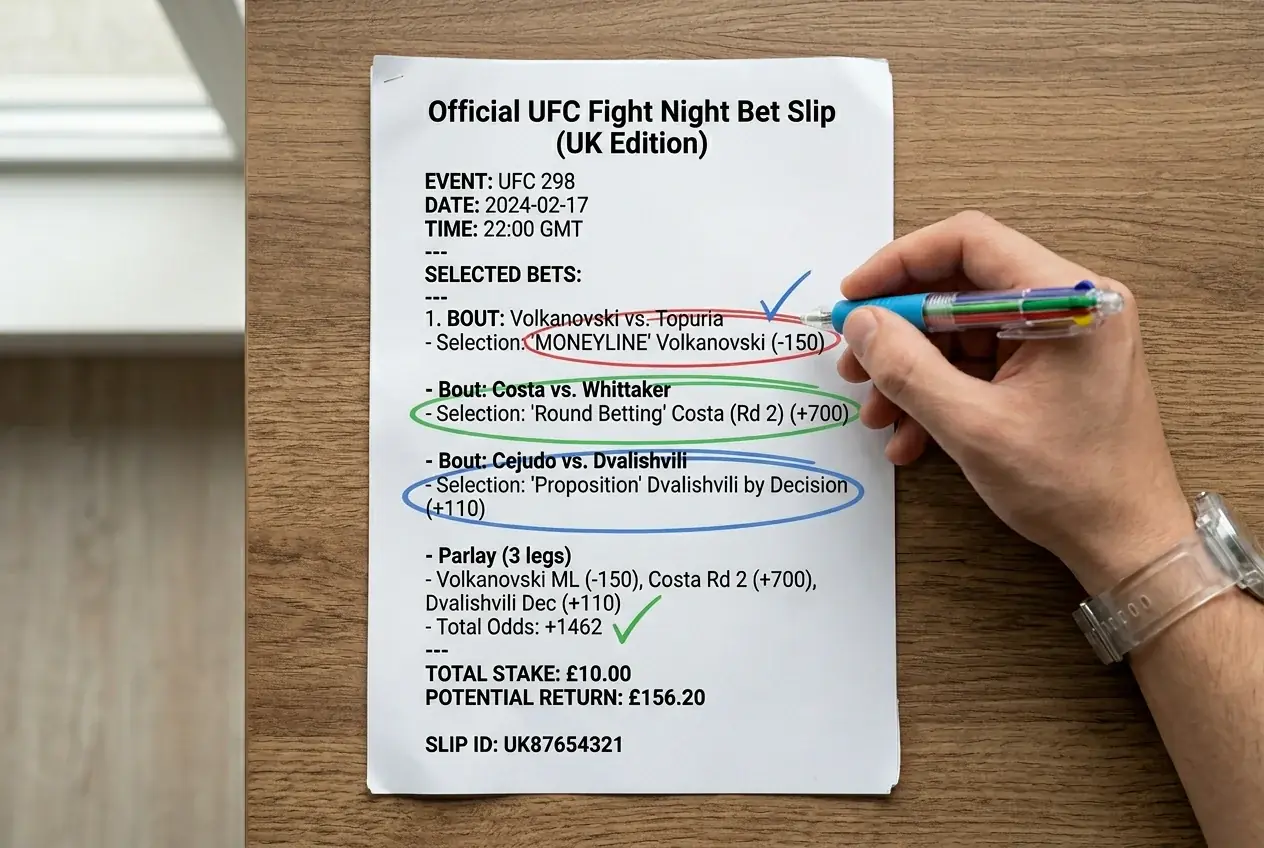
American odds are split into two camps by a sign. A negative number tells you how much you need to stake to win one hundred dollars. A positive number tells you how much you win on a one-hundred-dollar stake. So -150 means you risk $150 to win $100 — a favourite. And +220 means you risk $100 to win $220 — an underdog. The “$100” is a unit of reference, not a required stake.
To convert American to decimal, you handle the two signs separately. For a negative number, divide 100 by the absolute value and add 1. -150 becomes 100 ÷ 150 = 0.667, plus 1 equals 1.667. For a positive number, divide by 100 and add 1. +220 becomes 220 ÷ 100 = 2.20, plus 1 equals 3.20. The decimal is the same number you would see on a UK book; only the framing differs.
The reason American notation refuses to die is that it makes the favourite-underdog distinction visually instant. A negative number is the favourite. A positive number is the underdog. The sign tells you which side of the price you are on before you have read the digits. The cost is that the format is genuinely worse at the extremes — a 1.10 favourite is -1000 in American, which looks alarming and is impossible to read at a glance.
For practical UK use, the only time you really need to read American odds is when you are cross-checking with US-based MMA analytics. The community standard on those sites is American, and translating in your head saves the friction of opening a converter every time you read a tweet. If a podcast host says “Pavlovich opened at -350,” you should be hearing “Pavlovich opened at 1.286” without consciously doing the maths.
Implied probability and the search for an edge
If you remember one calculation from this article, make it this one. Implied probability tells you what the market collectively thinks about a fighter’s chance of winning. Every price you have ever bet on contains a probability hiding inside it. Most punters never extract it, and that is the largest reason they bleed money slowly across a year.
The formula for decimal odds is brutal in its simplicity. Implied probability equals one divided by the decimal odd. A fighter at 2.00 implies a 50% chance. A fighter at 1.50 implies 66.7%. A fighter at 4.00 implies 25%. That is the entire calculation.
For fractional, the calculation is a half-step longer. Take the denominator, divide by the sum of numerator and denominator, multiply by one hundred. So 7/4 implies 4 ÷ (7+4) = 36.4%. Evens (1/1) implies 50%. 1/2 implies 66.7%. The clean way is to convert to decimal first and run the simpler formula.
Now here is the part the textbooks skip. The implied probability you calculate from a single price is not the bookmaker’s actual estimate. It is the bookmaker’s estimate plus a slice of margin baked in so they make money regardless of who wins. If you add up the implied probabilities for both fighters in a UFC bout on a UK book, you will get a number greater than 100%. That excess is the overround. The better UK books currently run an overround under 4% on big UFC events, with the industry average sitting at five to seven percent.
To find the no-vig implied probability — the market’s actual estimate — divide each side’s raw implied probability by the total of both sides. If the favourite implies 62% and the underdog implies 42%, the total is 104% and the overround is 4%. Normalised: favourite is 62 ÷ 104 = 59.6%, underdog is 42 ÷ 104 = 40.4%. That is the market’s clean reading of the bout, with the bookmaker’s margin stripped out.
An edge exists when your honest estimate of a fighter’s chance to win is higher than the no-vig implied probability the market is offering. If you genuinely believe a fighter wins 50% of the time and the no-vig line says 45%, you have a five-point edge — assuming your estimate is right, which is the part that takes years. Without the calculation, you are guessing whether a price is good. With it, you can argue with the market on its own terms.
Overround, margin and how the bookmaker pays the rent
The cleanest way I have found to explain overround is this: imagine a coin-flip where the bookmaker offers 1.92 on heads and 1.92 on tails. Neither side is mathematically fair — a true fair price would be 2.00. The bookmaker is paying you less than the maths says they should, on both sides, and that gap is how they pay their rent regardless of which side comes up. Scale that to a UFC fight and you have the entire economics of the sport on a UK sportsbook.
The technical definition is straightforward. Overround is the sum of implied probabilities across all possible outcomes of a market, minus 100%. On a two-way UFC moneyline, add the implied probability of the favourite and the underdog. If the total is 104%, the overround is 4%. If it is 107%, it is 7%. That percentage point figure is the bookmaker’s theoretical margin — what they expect to keep if their pricing is balanced and the bets come in roughly proportional to the prices.
The UK MMA market in 2026 has a wider spread of margins than most punters realise. The best UK book runs an overround under 4% on major UFC events; the industry average sits at five to seven percent. That difference matters. On a £100 bet, a 4% overround takes about £3.85 from your expected return; a 7% overround takes about £6.54. Across a year of betting, that gap compounds into hundreds of pounds for an active punter.
The two-way fight winner market is the cleanest example, but method of victory and round groupings carry larger margins because the bookmaker is splitting probability across more outcomes and protecting each leg. A four-way method market — KO, submission, decision, draw/no contest — can carry an overround of nine or ten percent even on a sportsbook that prices the moneyline at four. That is why I will sometimes back the moneyline at 1.85 on a fighter and decline to back the same fighter at 2.10 to win by KO on the same book. The moneyline price is competitive; the method market is taxed.
The head of betting integrity at IBIA, Khalid Ali, made a related point about how monitoring at scale exposes pricing patterns: the greater scale and reach of the alert platform means detecting and assessing markets has increased materially. The takeaway for a punter is that a sportsbook with a tight margin is also typically the one with the most active trading desk — closer to market consensus than a soft book that has not bothered to adjust.
The practical implication: compare overrounds before you commit to a sportsbook for serious volume. A book with a margin under 5% on UFC moneylines is doing real trading. A book at 8% or higher is hoping you do not check.
How a UFC fight price moves in the week before the bout
The most useful thing I ever did as a young analyst was keep a spreadsheet of opening and closing prices on every UFC card for a full calendar year. Two hundred and fifty bouts in, the patterns stopped being theoretical. A fight price does not drift randomly — it responds to information, to flow, and occasionally to panic.
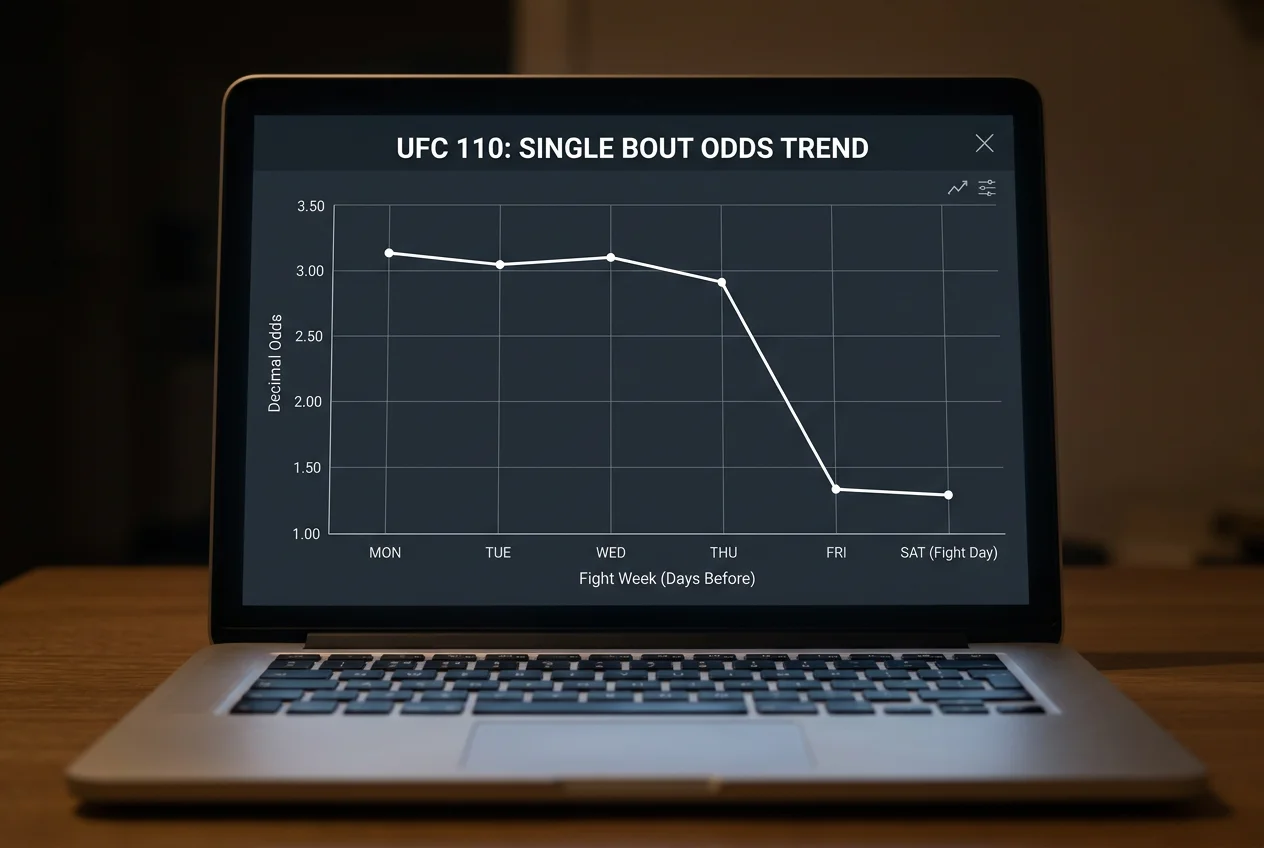
A UFC line typically opens on Monday or Tuesday of fight week, sometimes earlier for marquee bouts. The opening number is the trader’s best estimate before the public has reacted. From there it moves on two engines: the betting flow — money the book has to balance — and information shocks, like a missed weight, a press conference incident, or an injury rumour. Most of the action happens in the final 24 to 48 hours, and the closing line is the number you should treat as the market’s true reading of the fight.
The most dramatic movement I have seen in years was the Dulgarian versus Del Valle bout at UFC Vegas 110 in November 2025. Dulgarian opened at -250 — a sturdy favourite implying about 71% chance to win — and by the day of the fight had moved to -130, implying just 56.5%. That is a 15-percentage-point swing on a single fighter inside a week, with no public injury report and no missed weight. It was the kind of movement that triggers a phone call from an integrity service to a sportsbook compliance team, which is exactly what happened.
The lesson is not “follow the steam” — chasing line movement is a fast way to bet at terrible numbers. The lesson is to read movement as information about who is on the other side of your bet. A price moving sharply against the public favourite often means professional money is hitting the underdog. The size and direction of the move tells you which kind of money is winning the argument.
For the casual UK punter, my advice is to take a price you are happy with and stop checking the board. If the line moves in your favour after you bet, you have beaten the market. If it moves against you, the market has updated and you are now holding a price you could not get back. Refreshing the screen does not change your bet.
Odds boosts and promotional prices in the post-levy market
Every time a sportsbook emails me about a “boosted price” I open the standard market on a competing book and check the unboosted line. About half the time the boost is genuine value. The other half it is marketing on a price that was lazy to begin with. The 2025 statutory gambling levy of 1.1% of online gross gambling yield has reshaped how books offer these promotions.
Identify clean probabilities by learning to strip the bookmaker’s overround margin.
An odds boost is a sportsbook taking a standard market — typically a moneyline, a method of victory, or an accumulator — and increasing the price beyond what the trader’s model says is fair. It is marketing, not charity. The book accepts a worse expected return on that specific bet to acquire or retain a customer who, statistically, will keep betting on unboosted markets afterwards. Whether it is good for you depends on whether the boosted price, after the boost, beats the no-vig market consensus.
The test I run is simple. Take the boosted decimal, calculate the implied probability, then compare to the no-vig implied probability from a competitor’s standard market on the same bet. If the boost is offering a better-than-market price, it is positive expected-value. If it is offering a worse price even after the boost, the boost is a discount on a bad line.
The levy effect on promotions has been the under-discussed shift of the past year. With operators paying 1.1% of online GGY into the statutory pot from October 2025, the cheapest customer acquisition tactics have lost their margin. The result is fewer headline welcome offers, more conditional boosts on specific markets, and tighter terms on free bets. Boosts have become the surviving instrument because they can be targeted at specific bouts and limited in stake. Expect the trend to accelerate as the Remote Gaming Duty rise to 40% lands in April 2026.
One final caveat. Some “boosts” are not boosts at all — they are normal prices marketed as enhancements. If the boosted figure looks very close to what other books are showing on the same market, it is not a boost, it is a routine price wearing a sticker. The implied probability calculation is the only honest test.
Why are UFC odds shown as decimals on most UK sites?
Decimal is the format every modern UK sportsbook uses internally to feed price algorithms, cash-out engines and implied probability calculations. It is also more legible than fractional once prices get past evens, especially across long fight cards with many markets. Fractional is still available as a display toggle on most sites because regulation and customer habit have kept it alive, but the system underneath is running decimal.
What does an overround of 4% mean for my UFC bet?
It means that across both sides of the fight market, the bookmaker’s implied probabilities add up to 104% rather than the mathematically fair 100%. The extra 4% is the margin the book expects to keep over a balanced book of bets. On a £100 stake, an overround of 4% costs you roughly £3.85 in expected return versus a hypothetical zero-margin market. The best UK books run under 4% on big UFC events; industry average sits at 5 to 7 percent.
Are odds boosts ever a bad deal?
Yes, more often than the marketing implies. A boost is only good value if the boosted price, after the enhancement, beats the no-vig market consensus on the same bet. If the unboosted line was poor to begin with, a boost can simply be a discount on a bad price. The honest test is to convert the boosted decimal to implied probability and compare it to what other UK books are showing on the same market. If it does not beat the field, it is marketing rather than value.
Created by the ”Where can i bet on ufc” editorial team.