UFC Vegas 110: The Dulgarian-Del Valle Line Move
 Available in US
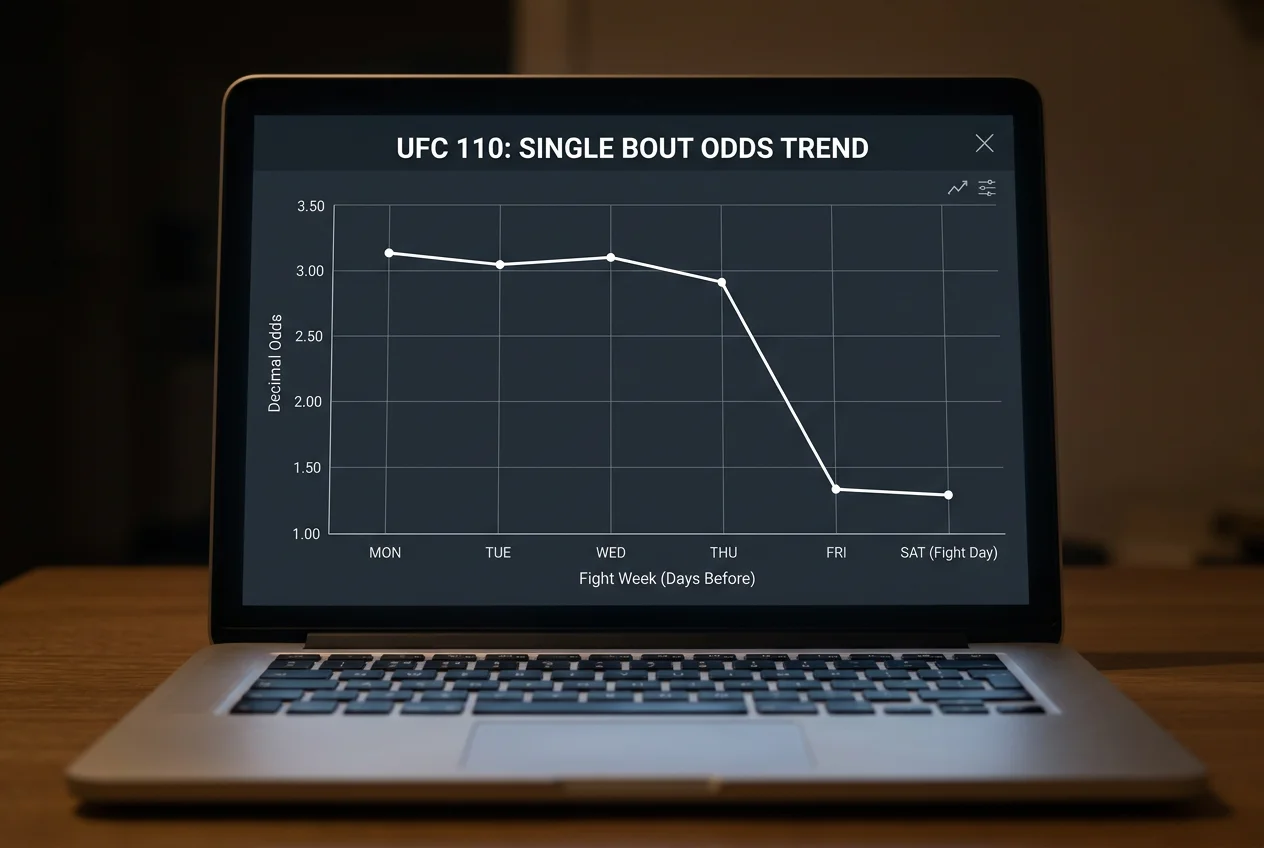
I have watched UFC betting markets for eight years and I can count the number of times a line moved like the Dulgarian-Del Valle market on one hand. Most line movement in MMA is gradual – sharp money trickles in, the price drifts a few cents, public action balances the book. The November 2025 Vegas card was different. The favourite’s price collapsed from -250 to -130 inside the day of the fight in a way that screamed something was wrong, and within 48 hours of the bout the UFC had contacted the FBI. The broader picture of UFC betting integrity in the UK sits in the integrity overview. This piece is the case study of how one bout exposed the integrity infrastructure of the sport.
The IBIA – the International Betting Integrity Association – recorded 300 suspicious betting alerts globally in 2025, a 29 percent rise from 232 the previous year. The Dulgarian-Del Valle market was one of them. The way the alert system worked through that fight is the clearest illustration the modern UFC betting ecosystem has provided of how integrity machinery actually functions.
Learn about real-time sports monitoring systems on the homepage.
The Bout and the Pre-Fight Prices
Isaac Dulgarian was the favourite. He opened at -250 in American terms, which translates to decimal 1.40 on UK books. The opponent, Yadier Del Valle, opened at +200, or decimal 3.00. The market was priced on form. Dulgarian had been on a strong run, the matchmaker had built a stylistic mismatch in his favour, and the early action followed the script.
The bout was on the prelim card of a UFC Apex Fight Night in November 2025. Prelim cards typically attract lower betting volume than main cards, which is relevant because lower-volume markets can move more dramatically on smaller absolute amounts of sharp action. A £10,000 bet on a heavily-bet football match barely moves the line. The same bet on a UFC prelim can shift the price by 20 to 30 cents in American terms.
For the first part of fight week, the market behaved normally. Dulgarian’s price drifted a touch shorter on initial sharp interest, then stabilised. Del Valle’s price stayed in the 3.00 region. There was no early warning sign in the opening days.
The Fight-Week Line Collapse
The line move that triggered the alert happened in the final 24 hours before the bout. Dulgarian’s price collapsed from -250 to -130 – meaning the implied probability of his winning fell from roughly 71 percent to 57 percent in a single day. In decimal terms, the favourite drifted from 1.40 to 1.77. The corresponding price on Del Valle shortened from 3.00 to about 2.10.
A 14-point move in implied probability on a UFC fighter inside 24 hours is extraordinary. It happens occasionally for legitimate reasons – a confirmed injury, a late weight-cut crisis, a public revelation about a fighter’s preparation – but those reasons are usually visible in news coverage. The Dulgarian move had no public catalyst. The price was moving on action that the trading desks could see in the betting data but for which there was no corresponding news story.
Sharp money was driving the move, and the volume of action coming in on Del Valle was unusual relative to typical prelim-card volume. Trading desks across multiple jurisdictions started flagging the market to their compliance teams. The integrity-monitoring services that track betting patterns across regulated and unregulated markets picked up the same signal independently.
By the time the bout was within an hour of starting, the price had stabilised at -130. The market had moved as far as it was going to move, and the question was no longer whether something was wrong but what to do about it.
The IC360 Alert and the UFC Response
IC360 is a sports integrity monitoring company that contracts with UFC and other major sports properties to provide real-time alert services. Their job is to spot suspicious betting patterns and notify the rights holder so corrective action can be taken before or during the event.
Dana White recounted the IC360 conversation in a TMZ Sports interview: “IC360 reached out and told us there was some unusual action going on with that fight and did we know anything. We didn’t. We called the fighter and his lawyer and said, ‘What’s going on? Are you injured? Do you owe anybody money?'” That sequence – the alert from the monitoring service, the call to the fighter, the absence of a satisfying explanation – is how integrity machinery is supposed to work.
The bout went ahead. Del Valle won, justifying the late line move on the betting markets but also confirming that whatever drove the action had a basis in something neither the public nor the bookmakers initially knew. Within days, the UFC had referred the bout to the FBI for investigation.
The FBI Referral and What It Covers
The FBI referral covers federal offences related to sports bribery and fraud. The investigation focuses on identifying who placed the unusual bets, whether the fighter or his camp were aware of or complicit in the betting activity, and whether any state or federal laws governing sports integrity were violated.
The investigation is ongoing as of early 2026 and the FBI has not publicly disclosed findings. Sports bribery cases typically take 12 to 18 months to reach charging decisions, and the Dulgarian-Del Valle case fits that timeline. The case has been reported by multiple outlets as one of the most significant UFC integrity referrals in recent years.
For UK punters, the practical impact has been limited because UKGC-licensed bookmakers refunded most stakes on the bout once the integrity flag was raised. Bets placed before the suspicious betting pattern was confirmed were generally settled normally, while bets placed during the window of suspect action were reviewed individually by each operator. The settlement decisions varied between operators, but most UK bettors who had small stakes on the bout saw their money returned.
Lessons for UK Punters
Three takeaways from how the case unfolded. First, sharp line movement without a public news catalyst is a warning sign worth respecting. If a UFC price moves 10 or more cents in implied probability inside a 24-hour window with no corresponding news, the smart money is moving on information you do not have. The right response is usually to stay out, not to follow the move.
Compare this investigation with past case studies such as our UFC 324 pulled bout case study.
Second, the integrity infrastructure now in place at the UFC works. The alert reached UFC within hours, the rights holder investigated, and the FBI was notified within days. Compare that to historic combat sports integrity scandals, which often took months or years to surface – the speed of the modern response is a structural improvement.
Third, UK regulation increasingly aligns with this monitoring infrastructure. The UKGC ran 9,700 compliance checks in 2024-2025 – more than double the 4,200 the previous year – and criminal cases through the regulator rose 300 percent year on year. UK-licensed operators are required to feed suspicious betting data into the same monitoring pools that flagged the Dulgarian case. The trade-off is that betting on a UKGC-licensed book carries less risk of being trapped in a case like this – the operator’s compliance machinery is part of the integrity solution rather than a blind spot.
Did UK bookmakers void Dulgarian-Del Valle bets after the alert?
Most UK bookmakers refunded stakes for bets placed during the window of suspect action, with bets placed before the line collapse settled normally. The decisions varied between operators because the line of when normal action ended and suspect action began was not the same at every book. Punters with small stakes generally saw their money returned in cases of doubt.
What is the FBI looking at in a UFC integrity probe?
The investigation covers federal sports bribery and fraud offences. The focus is on identifying who placed the unusual bets, whether the fighter or his camp had advance knowledge of or involvement in the betting activity, and whether any state or federal laws governing sports integrity were violated. Cases like this typically take 12 to 18 months before charging decisions are made public.
Prepared by the Where can i bet on ufc editorial staff.