UFC Cash Out: How UK Bookmakers Price an Early Exit
 Available in US
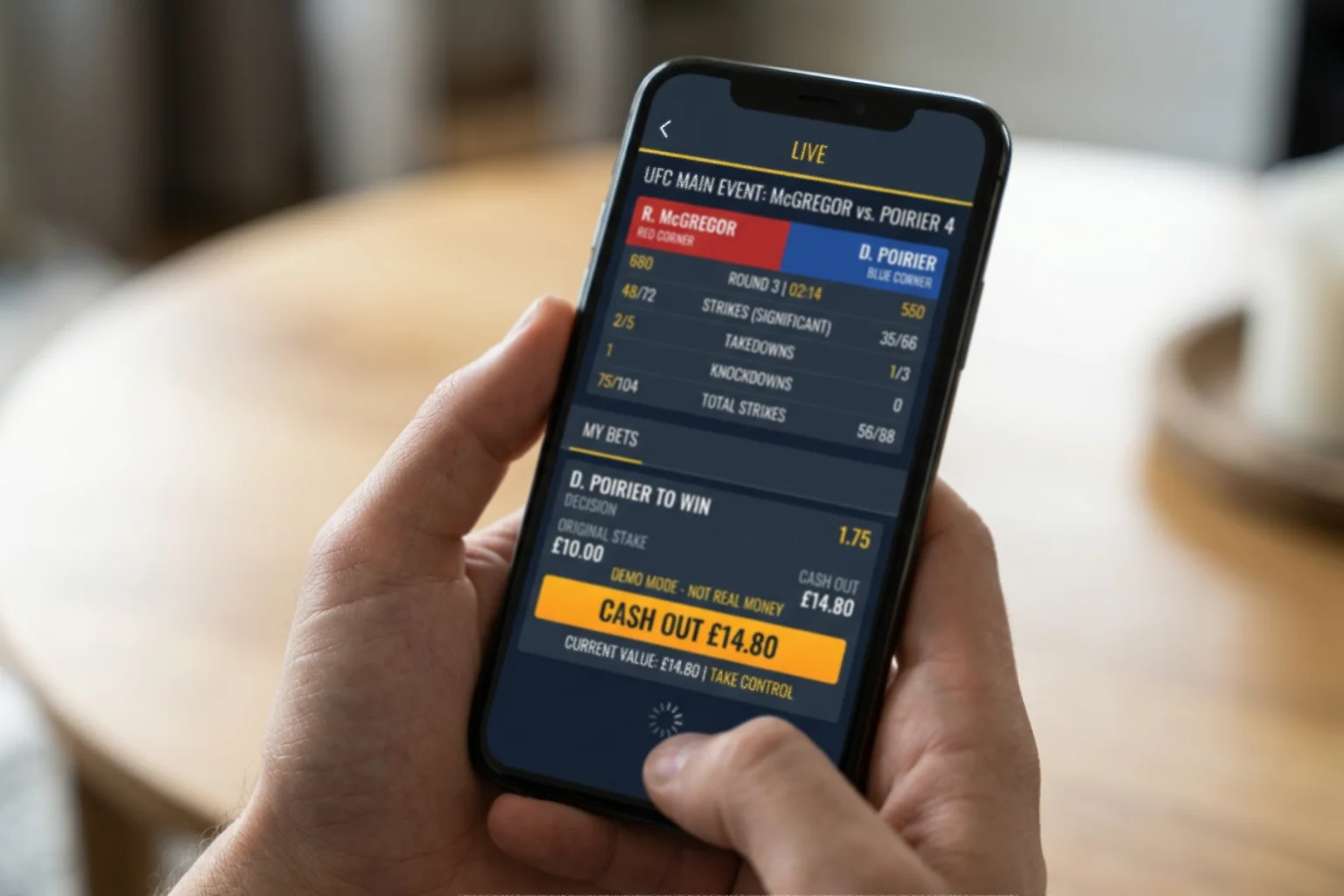
The cleanest cash out decision I ever made was on a UFC main event where I had backed the favourite at decimal 2.40 pre-fight, watched him dominate two rounds, and accepted a cash out offer of decimal 1.30 equivalent before round three started. The favourite was knocked out 90 seconds later. The cash out had locked in a profit that the actual fight result would have wiped out completely. The lesson, repeated across hundreds of in-play UFC bouts since, is that cash out is a tool – sometimes it saves you, sometimes it costs you, and the operator always makes money on the spread. The full live betting and streaming context across UK UFC markets sits in the UK live betting guide.
UFC remote betting in the UK is part of a £2.6 billion gross gambling yield segment, and cash out has become one of the most heavily-used features on that revenue. Understanding how the offered price is calculated, and where the operator’s margin sits within it, is what separates bettors who use cash out strategically from bettors who treat it as a free option.
Learn when it is mathematically sound to take an early exit on the homepage.
How Cash Out Is Calculated
The cash out price is built from the current live odds on the same market. If you backed the favourite pre-fight at decimal 2.40 and the live moneyline now sits at 1.50, the operator calculates what your bet is worth at the new price and offers you a cash out value based on that mid-fight valuation.
The maths is straightforward in principle. Your original bet pays out a defined amount if it wins. The current live odds suggest a probability of that outcome happening. Multiply the probability by the payout and you get the bet’s current expected value. Subtract a margin for the operator and you get the cash out offer.
The margin baked into the cash out is the bit punters underestimate. On a typical UFC main event, the cash out margin sits around 5 to 10 percent of the expected value of the bet – so a bet currently worth £100 in expected value might be offered at cash out for £90 to £95. The operator captures the difference as profit on the transaction. Across thousands of cash outs on every UFC card, that margin adds up to a meaningful revenue stream.
The faster the markets are moving – between rounds, during knockdowns, in the final seconds of a round – the wider the cash out margin gets. Volatile markets are riskier for the operator to price, so the spread widens to compensate. Cash outs offered during a quiet round are typically tighter than cash outs offered during a flurry of action.
Partial Cash Out Explained
Partial cash out lets you take some of the bet off the table while leaving the rest live. You staked £40 on a UFC favourite at decimal 2.50, and the partial cash out offer lets you take, say, £30 of the current £80 expected value out as cash, leaving £25 of the original stake live for the rest of the bout.
The mathematics is the same as a full cash out applied to a fraction of the stake. The operator margin still applies, scaled proportionately. Partial cash out is useful when you want to lock in some profit but still have exposure to the original bet outcome. It is most often used in the championship rounds when a favourite is winning the cards but a late-round knockout would flip the bet.
The downside of partial cash out is that the operator margin is paid twice – once on the partial cash out, and once if you take a second partial cash out or full cash out later. A bettor who uses partial cash out three times across a single five-round bout pays the operator’s margin three times on the same underlying bet.
For UFC specifically, partial cash out makes most sense on five-round main events where the bout has multiple decision points. On three-round prelim bouts, the bout is over quickly enough that a single full cash out is usually the cleaner play.
When Cash Out Is Suspended
Cash out availability is not constant. Most UK operators suspend cash out during fight-defining moments – knockdowns, submission attempts, dramatic exchanges – because the trading desk cannot price the bet reliably while the outcome is in flux. Suspension typically lasts 30 to 90 seconds, after which cash out returns at a price that reflects the new fight state.
Suspension is also common in the final seconds of a round. The trading desk does not want to offer a cash out that gets accepted at the buzzer if the next round is about to change the price dramatically. Most operators block cash out for the final 20 to 30 seconds of each round.
Some bettors find these suspensions frustrating, particularly when they want to lock in profit during a one-sided beating. The operator’s logic is risk management – if you can cash out at the price quoted before a fight-ending sequence, the operator pays full value on a bet that would have lost anyway. The suspension protects the operator from giving away expected value to bettors with faster reflexes than the trading desk.
Network delays add to the friction. UK punters watching UFC on TNT Sports may be 20 to 40 seconds behind the actual cage action because of broadcast lag. By the time the in-play price reflects what just happened, the punter who relies on the broadcast feed is already too late.
Cash Out on Bet Builders and Accumulators
Cash out on bet builders is available at some UK operators but not all. The mechanics are more complex because the builder has multiple legs that may each be in different settlement states. Some legs may have already settled, others may still be live. The cash out price reflects the current expected value of the remaining live legs.
The operator margin on bet builder cash out tends to be wider than on single-fight cash out because the complexity of pricing multi-leg constructions in real time is harder to model. A bet builder cash out might carry a 10 to 15 percent margin compared to 5 to 10 percent on a single-bet cash out.
Accumulator cash out is offered on most multi-bet products but availability depends on the live status of each leg. If one leg is mid-event, the operator can price the remaining legs in real time. If multiple legs are pending future events, the cash out reflects an estimate of those legs that may diverge significantly from the actual closing prices when those events arrive.
Is Cash Out a Bookmaker Margin Trap
Cash out is positive expected value for the bettor in some situations and negative in others. The honest answer is that it depends on the specific bet, the timing, and the bettor’s read on the fight state.
Time your exits with precision when placing live in-play fight betting.
Cash out is useful when you have a real edge on the remaining fight state. You backed a favourite who is winning the cards but appears physically compromised – fatigued, cut, breathing heavily – and the live price has not adjusted to that physical reality. Cashing out at a tight margin captures value that the trading desk has not yet priced in.
Cash out is a trap when you are using it to manage anxiety rather than to capture mispricing. The bettor who cashes out every winning UFC bet at a 10 percent operator margin gives away expected value across the long run that compounds dramatically. The discipline is asking whether you would place the inverse bet at the cash out price. If you would not, the cash out is probably defensive rather than rational.
Why does cash out disappear during the last 30 seconds of a UFC round?
The trading desk suspends cash out during the final seconds of each round because the price can change dramatically based on whether the round ends with a finish, a knockdown, or no significant action. Offering cash out at the pre-buzzer price would expose the operator to paying full value on bets that the next round is about to render losers. Cash out returns after the round-end transition is processed.
Do I pay extra margin to cash out a UFC bet?
Yes, indirectly. The cash out price contains a margin of 5 to 15 percent relative to the bet’s actual expected value at the current live odds. The operator captures that margin as profit on the cash out transaction. Cash out is positive expected value for the bettor when they have information the live market has not priced in, and negative expected value when used routinely without specific edge.
Written by the editors at Where can i bet on ufc.