
MMA Value Betting: A Framework for UK Punters
 Available in US
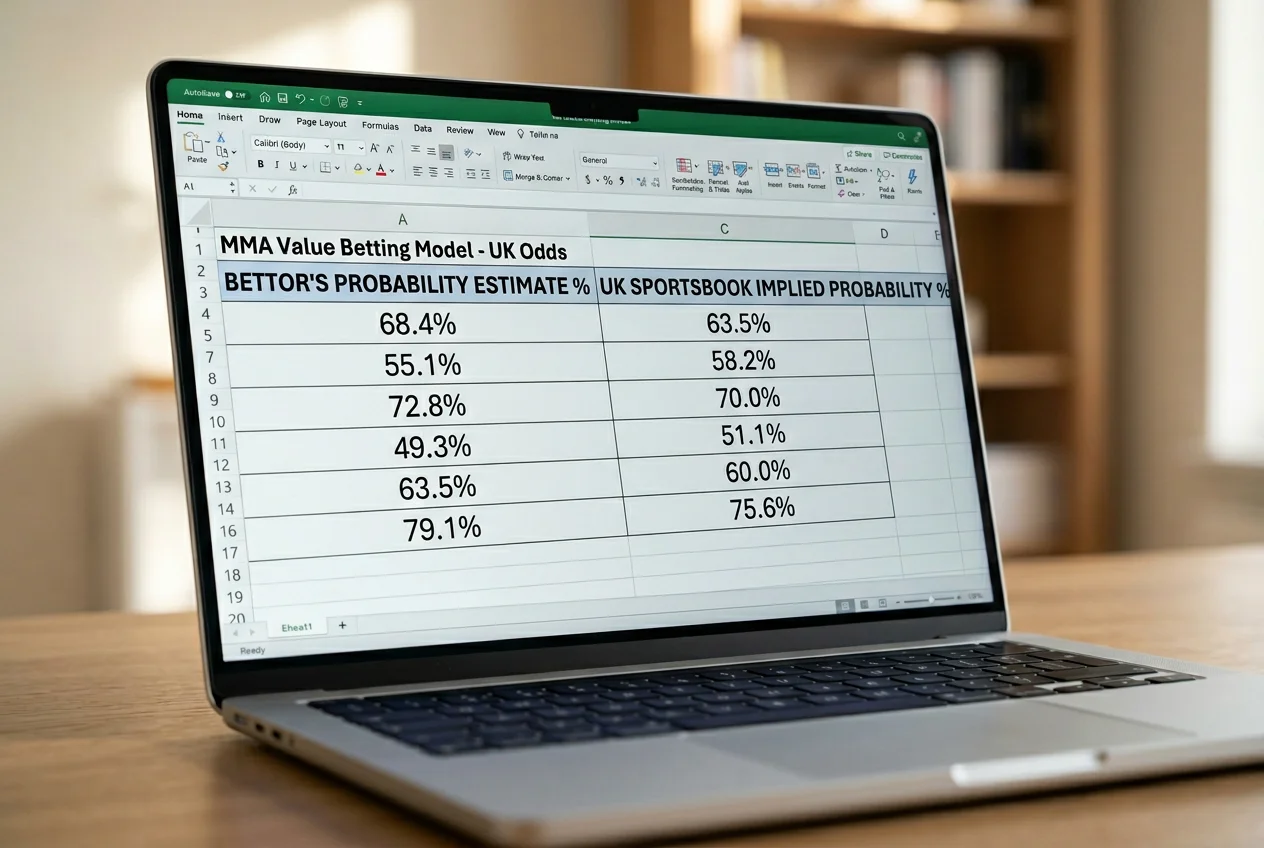
The single best UFC bet I made in 2024 was on an underdog at decimal 4.50 in a co-main event where my probability model gave the fighter a 30 percent chance of winning. The market had him at 22 percent implied probability. The bet hit, and the post-match analysis confirmed the styles-and-conditioning case I had made pre-fight. The lesson – repeated across many smaller value bets that have landed over eight years – is that value betting in MMA is a mathematical discipline, not an intuition game, and the punters who treat it as the former make money over time while the punters who treat it as the latter slowly lose.
Khalid Ali, the CEO of the International Betting Integrity Association, captured the structural reality in a comment about the IBIA Global MAP platform: “Our 2025 data highlights a familiar integrity risk pattern, with football and tennis continuing to account for most suspicious betting activity. At the same time, the greater scale and reach of our Global Monitoring & Alert Platform means our ability to detect, assess and support investigations across markets and sports has increased.” For UFC value bettors, the implication is twofold – the markets are more efficient than they used to be, but the integrity infrastructure also means that genuine analytical edge is more findable because the market noise from manipulation has been reduced.
Learn how to build mathematically sound models on our main website.
What Value Actually Means
Value in betting has a precise meaning. A bet has value when the implied probability from the price is lower than the probability of the bet actually winning. If your probability model gives the fighter a 30 percent chance of winning and the market price implies 22 percent, the bet has 8 percentage points of value. Stake the bet enough times across enough events and the expected return is positive.
The discipline most punters miss is the distinction between value and likelihood. A bet that is likely to win can be poor value if the price is too short. A bet that is unlikely to win can be good value if the price is generous enough to compensate. Value is independent of comfort – the bets that feel best are not necessarily the bets that pay best.
The best UK UFC sportsbooks price their main events with an overround as low as 4 percent, with the industry average sitting between 5 and 7 percent. The lower the overround, the harder value is to find because the market is closer to fair. UK punters who consistently find value tend to do so against the slower-moving soft books rather than the sharp books, but the trade-off is that the soft books also restrict winning accounts more aggressively.
Building Your Own Probability Estimate
The mathematical core of value betting is your probability estimate. The market’s number is visible – the implied probability from the price. Your number is what you bring to the trade. The difference between the two is your edge.
For UFC, the probability estimate has to account for fighter style, recent form, the matchup-specific styles interaction, conditioning, weight-cut implications, and a smaller weight on more variable factors like the venue and the build-up. The components combine into a single percentage that you assign to each fighter.
My personal approach uses three building blocks. First, a base rate from the moneyline overround-adjusted no-vig price. The market knows things you do not, and starting from its consensus is more efficient than trying to build a probability from scratch. Second, adjustments for matchup-specific factors that the market may not have fully captured – a fighter’s record against southpaws, the takedown defence track record against high-percentage wrestlers, the chin durability against specific power profiles. Third, a small subjective adjustment for fight-week information – weight-cut struggles, illness rumours, sparring partner reports.
The discipline is keeping your adjustments small and disciplined. Most professional UFC bettors I have spoken to over the years adjust the market price by no more than 5 to 8 percentage points in either direction, unless they have very specific information. Larger adjustments invite over-confidence, and over-confidence is what produces the losses that erase a year of careful gains.
Comparing Against the No-Vig Line
The no-vig line is the market’s probability estimate stripped of the bookmaker’s margin. Building your own estimate and comparing it to the no-vig line is the most reliable value-detection method available to retail bettors.
If your estimate exceeds the no-vig probability by enough to beat the bookmaker’s margin plus a buffer, the bet is value. The buffer matters because your model has noise. A model that gives 30 percent against a no-vig number of 22 percent has 8 percentage points of headline value, but if your model has standard error of plus or minus 3 percentage points, the genuine value is closer to 5 percentage points after accounting for model uncertainty.
The full mechanics of stripping the overround and producing a no-vig line sit in the no-vig calculation walkthrough. The walkthrough is essential reading for any UFC bettor who wants to take value betting seriously, because the no-vig line is the comparator against which every value claim must be tested.
Lower-Tier MMA as a Value Source
UFC main events are heavily priced by sharp money and the value windows are narrow. Lower-tier MMA promotions – regional shows, secondary leagues, prospects making their way up – are priced with less information and the value windows are wider.
The trade-off is that lower-tier MMA carries higher variance. The fighters are less established, the matchmaking is more variable, and the prediction error on any given bout is larger. The wider value windows are real, but the variance can wipe out a long run of good bets in a short losing streak.
For UK punters, the practical strategy is mixing UFC main events with selective lower-tier exposure. The UFC bouts provide the steady volume and the analytical baseline; the lower-tier bouts provide occasional higher-value opportunities when your specialist knowledge of a regional prospect or scene gives you an information edge over the trading desks. Most UK books do not price lower-tier MMA as carefully as they price UFC, which is the structural reason the value windows are wider.
Closing Line Value as a Feedback Loop
Closing line value is the gold-standard test of whether your value-betting process is working. If you consistently bet at prices longer than the closing line – meaning the market moved against your initial bet between placement and the bout starting – your bets are systematically capturing value the market eventually agrees with.
Calculate fight prices accurately by learning how to calculate a true no-vig UFC fight price.
The tracking is simple. For every bet, record the price you placed at and the closing price for the same market. Calculate the closing line value as the difference between the two prices, expressed as a percentage. A closing line value of plus 5 percent across a hundred bets is strong evidence of genuine analytical edge. A closing line value of zero or negative suggests your bets are roughly priced and the apparent wins are variance rather than skill.
The feedback loop matters because betting results are noisy in the short run. A profitable hundred-bet sample can be variance. A profitable sample combined with positive closing line value across the same sample is much more likely to be genuine edge. The closing line value is what separates lucky bettors from skilled ones, and tracking it is the discipline that lets you tell which one you are.
How big an edge do I need to bet on a UFC underdog?
My personal rule is at least 4 percentage points of probability edge against the no-vig line for an underdog bet, compared with 3 points for a favourite. Underdogs need a wider edge because longshot variance is brutal – a 20 percent shot loses four times out of five even when the bet is fairly priced. The wider edge compensates for the variance and creates enough margin of safety to absorb model error.
Is closing line value a good benchmark for casual UFC bettors?
Yes. Closing line value is the most reliable single indicator of whether your bets are systematically capturing analytical edge or relying on variance. A positive closing line value across a hundred-plus bet sample is strong evidence that the market eventually agrees with your reasoning, regardless of whether the individual bets won. Casual bettors who track closing line value learn faster whether their process is working than bettors who only track profit and loss.
Prepared by the Where can i bet on ufc editorial staff.